Sunday, January 27, 2013

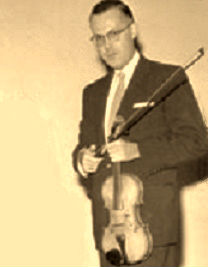
Berl Senofsky

Berl Senofsky was a Russian violinist and teacher (most people would say American) born (in Philadelphia) on April 29, 1926 – one source gives his year of birth as 1925.  He was known for his strong, focused sound and his strong convictions, whether on music topics or otherwise.  He actually emerged from the ranks of orchestra players to become a concert violinist and teacher.  Joseph Fuchs did essentially the same thing, though he spent many more years in an orchestra than did Senofsky.  Senofsky began his violin studies at age 3, with his father, who himself had studied with Efrem Zimbalist and Mischa Elman.  At age 6 (1932) he began studying with Louis Persinger, who was teaching Yehudi Menuhin, Ruggiero Ricci, Isaac Stern, Hermilo Novelo, Guila Bustabo, Camilla Wicks, and many other violinists at about the same time.  According to one source, Senofsky also studied with Paul Stassevitch at the Mannes School of Music from age 9.  Persinger began teaching at Juilliard (New York) in 1930.  Senofsky may have been studying privately with Persinger since he did not enroll at Juilliard until age 12.  From then on, his teacher was Ivan Galamian.  Senofsky’s career was interrupted by World War II in 1944.  However, after his brief military service, he made his debut in New York in 1946.  He was 20 years old.  He had by then won the Walter Naumberg Award, one of the top prizes for violinists.  After further study with Galamian – an additional 4 years – he concertized for a short while.  He first appeared with the New York Philharmonic on July 11, 1950, playing the Brahms Double concerto.  The cellist on that occasion was Shirley Trepel.  Senofsky eventually took a position with the Cleveland Orchestra in 1951, as assistant concertmaster.  Joseph Gingold was the concertmaster at the time.  He was there until 1955.  In that year, he won the Queen Elizabeth competition in Belgium.  From that point on, he concertized far and wide, focusing his initial (and extensive) concert activities on Russia.  On January 15, 1959, he again played with the New York Philharmonic.  The concert was repeated four times and the work he played was the Brahms concerto.  With William Walton on the podium, Senofsky appeared with the same orchestra on August 8, 1963, playing the Walton concerto.  On July 28, 1973, he was for the last time featured with the New York Philharmonic, performing the Scottish Fantasy by Max Bruch.  He was 47 years old.  From 1965 until 1996, Senofsky had a teaching job at the Peabody Conservatory in Baltimore.  He was also concertizing around the world during all that time.  Although he recorded for four (or five) different labels, Senofsky only recorded sporadically, but his recordings can still be easily found.  A YouTube audio file is here.  Among other violins, Senofsky played a 1771 Tomas Balestrieri violin which was later played by Ruggiero Ricci and a 1757 Carlo Landolfi later on.  He loved playing chamber music but I could not find any mention anywhere indicating he actually played chamber music in public.  A quote attributed to Senofsky goes something like this: "To me, music is a higher calling than just a profession or living. It is an effort in understanding something bigger than yourself--it is an effort at striving to be something bigger than you are. You can define religion that way too."  Senofsky died on June 21, 2002, at age 76.  

Monday, January 21, 2013

Andor Toth

Andor Toth was a Hungarian (many would say American) violinist, pianist, conductor, and teacher born (in New York City) on June 16, 1925.  He is remembered for a career which encompassed diverse fields in music – Broadway shows, chamber music, orchestral playing, concertizing, and teaching.  He began violin lessons at age 8.  Before long, he ended up going to Juilliard (New York) and joined the NBC Symphony in 1943, under the ill-tempered conductor, Arturo Toscanini, at age 18.  He only stayed a year.  At Juilliard, his teachers were Hans Letz and Ivan Galamian.  Toth played for U.S. troops in Europe during the war, although as a civilian.  Afterward, Toth was associate concertmaster of the Cleveland Orchestra.  Joseph Gingold was the concertmaster at that time.  Toth then went to Houston to be associate conductor of the Houston Symphony.  From 1955 to 1960, Toth taught at the Oberlin Conservatory of Music (Ohio, USA.)  He was a Broadway show conductor (New York) for a year after that – 1960-1961.  From 1961 to 1989, he taught at various schools, including the Oberlin Conservatory of Music, California State University, the University of Colorado, New College of Florida, University of Texas, Oberlin (again), San Francisco Conservatory, Stanford University, the University of Arizona, and the University of Houston.  He retired in 1998.  During his teaching career, Toth organized or played in various chamber ensembles, including the Oberlin String Quartet, the Alma Trio, the New Hungarian String Quartet, the Takacs String Quartet, and the Stanford String Quartet.  As a soloist, he appeared with various orchestras, including the Cleveland Orchestra, the Houston Symphony, and the Los Angeles Chamber Orchestra, of which he was concertmaster in 1969.  His students include David Zinman and Charles Barber.  Toth died (in Los Angeles) on November 28, 2006, at age 81. 

Sunday, January 13, 2013

Jascha Brodsky

Jascha Brodsky was a Russian (Ukrainian) violinist and teacher born (in Kharkof aka Kharkiv) on June 6, 1907.  Although he began his career as a concert violinist, he is primarily remembered as a great violin pedagogue, in the same league as Peter Stolyarsky, Carl Flesch, Leopold Auer, Zakhar Bron, Ivan Galamian, and Josef Gingold.  Brodsky shares a surname with another (not related) famous violinist: AdolphBrodsky.  His first lessons (at age six) were with his father.  Such was also the case with Jascha Heifetz and his father.  He also studied at the music conservatory of Tblisi (Georgia) and began concertizing in Russia, appearing with several orchestras in Russia in his early teens.  He left for Paris in 1926.  He was 19 years old.  In Paris he studied with Lucien Capet and later on, in Belgium, with Eugene Ysaye.  During that time, he played with Nathan Milstein and Vladimir Horowitz.  Milstein and Horowitz were very close friends and had fled Russia at almost the same time in 1925.  In 1930, with advice from Mischa Elman, Brodsky became a student of Efrem Zimbalist at the Curtis Institute (U.S.).  In 1932, he began teaching at Curtis.  By then, he had also become first violinist of what became the Curtis String Quartet, with Benjamin Sharlip, Max Aronoff, and Orlando Cole.  The quartet was invited to play at the White House at a later time.  It was also the quartet for whom Samuel Barber wrote his string quartet - the one that includes the famous Adagio (Opus 11, completed in 1936.)  The Curtis String Quartet did not, however, premiere the Barber quartet - Barber did not finish it in time.  Barber's Opus 11 was premiered by the Pro Arte Quartet in late 1936 in Italy and was subsequently revised and re-premiered by the Budapest String Quartet in the U.S. in 1943.  Brodsky retired from the quartet in 1981 and from Curtis in 1996.  He was 88 years old.  An audio file of Schumann's Opus 41, number 1 (with Louis Berman on second violin) can be heard here in its entirety.  He also taught (from 1942 onward) at the New School for Music (later – in 1986 - merging with Temple University) in Philadelphia.  His students include Jaime Laredo, Judith Ingolfsson, Juliette Kang, Judy Barrett, Julie Kurtzman, Joey Corpus, Hilary Hahn, Alan McChesney, Herbert Greenberg, Monica Bauchwitz, Ellen de Pasquale, Joseph de Pasquale, Robert de Pasquale, Levon Zarasian, Martin Chalifour, Chin Kim, Leila Josefowicz, and Nadia Salerno-Sonnenberg.   For a short while, Brodsky played – on loan from Curtis – the 1697 Molitor Stradivarius.  Curtis acquired the Molitor in 1929 but got rid of it in 1936.  The Molitor has been around a bit and is now owned by Anne Akiko Meyers - it had been previously played by Henri Temianka and (more recently) Elmar Oliveira.  For about ten years, Brodsky also played a Stradivarius violin from 1694, also from the Curtis Institute’s collection.  The violin had previously been owned by Karl Halir.  Curtis sold it in 1947.  I don’t know what violin Brodsky played after that. He died (in Ocala, Florida) on March 3, 1997, at age 89.  

Friday, January 4, 2013

Christian Tetzlaff

Christian Tetzlaff is a German violinist and teacher born (in Hamburg) on April 24, 1966.  As was Joseph Szigeti, he is known for his intellectual approach to playing, though that is a very limiting characterization of his style.  He is also one of the few (male) violinists who does not wear casual clothing when performing and does not make an issue of appearing “non-elitist” by wearing casual clothes when he performs.  Joshua Bell, Leonidas Kavakos, Stefan Jackiw, Gilles Apap, and Nigel Kennedy (among others) have long-ago abandoned the formal attire of a traditional concert violinist (white tie and tails) in favor of grungy and casual clothes.  His three siblings are also professional musicians, as were all four Spivakovsky brothers.  He is also rather unique in that he favors a modern violin to his Stradivarius.  Tetzlaff did not enter a conservatory as a child, as have many violinists before him.  He took up the violin at age 6 but proceeded to get a regular academic education.  At age 14, he made his orchestral debut playing the Beethoven concerto.  After that, he studied with Uwe-Martin Haiberg at the Lubeck Music School – Lubeck is about 40 miles north of Hamburg.  In 1985, he came to the U.S. to study with Walter Levin (pupil of Ivan Galamian) at the University of Cincinnati.  He was 19 years old.  He has subsequently played with virtually every major orchestra in the world and has given recitals in the most important venues as well.  Though his discography is not extensive, every one of his recordings has been highly praised.  There are many classical music lovers who consider him underrated by critics and the general public.  The same thing has been said many times of Pinchas Zukerman.  YouTube has several videos of his performances.  Here is one with the Brahms concerto.  Tetzlaff is the only violinist I know who regularly plays all of the Bach Partitas in one single program.  Several others do play all of the Paganini Caprices in a single recital but he prefers doing that with Bach.  Tetzlaff organized the Tetzlaff String Quartet (with Elisabeth Kufferath, Hanna Weinmeister, and Tonja Tetzlaff) in 1994.  He was 28 years old.  Since 2002, his violin of choice has been one by German Luthier, Peter Greiner.  It sounds like a Stradivarius, if not better.  Leonidas Kavakos also owns a Greiner violin.  Tetzlaff teaches at the Kronberg Academy, situated near Frankfurt, Germany.  A famous quote by Tetzlaff goes like this: “Trying to turn lead into gold is nothing compared to taking something mechanical like an instrument – a string and a bow - and using it to evoke a human soul, preserved through the centuries.”  

Friday, December 28, 2012

Daniel Guilet

Daniel Guilet (Guilevitch) was a Russian violinist (some would say French or American) born (in Rostov) on January 10, 1899.  Although he was for a few years concertmaster of the famous NBC Symphony under the ill-tempered Arturo Toscanini, he is better known as the original violinist and founder of the Beaux Arts Trio.  His parents moved from Russia to Paris before the turn of the century, and he later trained at the Paris Conservatory with George Enesco.  After graduation, he toured Europe as a recitalist with Maurice Ravel as his accompanist.  He also played second violin in the Calvet String Quartet (with Joseph Calvet, Leon Pascal, and Paul Mas.)  A YouTube audio file of one of their recordings can be found here.  Guilet came to the U.S. in 1941.  He was about 41 years old.  He soon formed a quartet (which at various times included Henry Siegl, Jac Godoretzky, William Schoen, Frank Brieff, David Soyer, and Lucien Laporte) under his own name.  A YouTube performance by this quartet can be heard here.  Three years later (1944) he joined the NBC Symphony.  Seven years after that (1951), he became its concertmaster and remained in that position after Toscanini retired in 1954, although the orchestra had to change its name – a string quartet from the NBC orchestra which included Emanuel Vardi and Daniel Guilet, used to play for the retired maestro at his home almost every Sunday in order to cheer him up.  In that same year (1954), Guilet formed the Beaux Arts Trio with pianist Menahem Pressler and cellist Bernard Greenhouse.  The trio gave its first concert on July 13, 1955 and its last on September 6, 2008.  Guilet retired from the trio in 1968 and from playing altogether (publicly) in 1969.  The trio (featuring Guilet) has a few audio files on YouTube although files and videos with subsequent violinists are more numerous.  One such audio file is here.  After his retirement, Guilet taught at Indiana University, the Manhattan School of Music, the Royal Conservatory in Canada (Montreal), Oklahoma University, and Baylor University (Waco, Texas.)  He owned a JB Vuillaume violin from 1867, a Carlo (or Michele Angelo) Bergonzi from 1743, and a 1727 Guarnerius Del Gesu which he got rid of in 1973 (after he retired from playing) and which passed through the hands – perhaps in 1998 - of infamous violin dealer Dietmar Machold, who is now in prison for defrauding clients and banks.  I’m guessing Guilet used the Vuillaume and Bergonzi violins for most of his recordings since the Guarnerius was not acquired until 1965.  The violin now bears Guilet’s name.  Guilet died in New York on October 14, 1990, in relative obscurity, at age 91.  

Thursday, December 27, 2012

Sherlock Holmes quote

“There is nothing more to be said or to be done tonight, so hand me over my violin and let us try to forget for half an hour the miserable weather and the still more miserable ways of our fellowmen.”  - Arthur Conan Doyle, quoting Sherlock Holmes 
Holmes was talking about the London weather, which can sometimes be nasty. The quote is from the story entitled The Five Orange Pips. If you have played for some time, you know full well that once you get "into" your playing, you forget pretty nearly every other problem or concern you have - the violin is like a refuge from mundane matters. Perhaps the reason is not a poetic one, but a practical one - it takes a lot of concentration so you are simply not able to focus on anything else with meaningful intensity. 

Sunday, December 23, 2012

Robert Schumann quote

“If we were all determined to play the first violin we should never have an ensemble.  Therefore, respect every musician in his proper place.”  Robert Schumann, pianist-composer   

Schumann had the right idea. Throughout history, the orchestra has supported innumerable musicians of considerable talent. Many orchestral players have gone ahead to forge great music careers after leaving the orchestra. Those players include Israel Baker, Max Bendix, Elias Breeskin, Pablo Casals, Carmine Coppola, Joseph Joachim, Louis Spohr, Heimo Haitto, Neville Marriner, Frank Miller, Charles Munch, Eugene Ormandy,  Arturo Toscanini, Janos Starker, Roberto Diaz, Mischa Elman, Zino Francescatti, Leonard Rose, Joseph Fuchs, Milton Katims, William Primrose, Josef Gingold, Daniel Guilet, Alan Gilbert, Felix Galimir, Orlando Barera, Mischa Mischakoff, Louis Persinger, Andor Toth, Gerard Schwarz, Oscar Shumsky, Peter Stolyarski, Theodore Thomas, Lynn Harrell, Jaap Van Zweden, Emanuel Vardi, Tossy Spivakovsky, and Eugene Ysaye.  You never know if you'll be sharing a stand with the  next Mischa Elman, Alan Gilbert, or Arturo Toscanini.