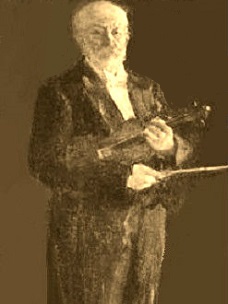
Joseph Roisman (Josef Roismann) was a Russian (Ukrainian) violinist born (in
Odessa) on July 25, 1900. He is best
known for playing in the Budapest String Quartet from 1927 to 1967. Prior to 1932 he played second violin and
then played first violin from 1932 onward.
Although he was a very prominent chamber music player, known throughout
the world, there is scant information about him on the internet and no
Wikipedia article on him. He began his
violin studies at age 6. One source
states that his first teacher was Peter Stolyarsky although that is highly debatable
since prominent pedagogues like Stolyarski never take on beginners. From Odessa the family went to Berlin where
Roisman studied with Alexander Fiedemann.
In 1914, they returned to Odessa where the young Roisman studied with
Naoum Blinder at the Imperial Conservatory.
After graduating, he was appointed concertmaster of the Odessa Opera
Orchestra. After the 1917 revolution,
Roisman made a living in Russia playing in farms and factories. In 1923, he left Russia and soon settled in
Prague, playing in the Czech Philharmonic and in cafes. By 1925, he had arrived in Berlin where he
landed a job in a movie theatre orchestra.
According to one source, the theatre orchestra paid better than the
Berlin Philharmonic. He supplemented his
income by playing in cafes there too. He
joined the Budapest Quartet after auditioning in the spring of 1927. He played his first concert with the quartet
on September 17, 1927 in Oslo, Norway – it was an all-Beethoven program. Roisman, as far as I know, never played solo
concerts or recitals. Here is an audio
file of the quartet playing a Haydn quartet in (circa) 1925, prior to
Roisman's joining. Here is a recording (from 1934) of a Mozart
quartet, including Roisman and the players which lasted the longest
with the Budapest String Quartet and are traditionally associated with it. Roisman played a Domenico Montagnana violin constructed
in 1723 and a magnificent 1785 Lorenzo Storioni. Joseph Roisman died on October 10, 1974, at
age 74.
Showing posts with label Peter Stolyarsky. Show all posts
Sunday, December 27, 2015
Sunday, December 13, 2015
Naoum Blinder
Naoum Blinder was a Russian (Ukrainian) violinist and teacher born (in
Lutzk) on July 19, 1889 – since various sources vary his exact date and place
of birth are approximate. He is best
remembered for being one of Isaac Stern’s teachers – between 1932 and 1935. He was a touring concert violinist for a
while but finally settled in San Francisco to become the orchestra’s
concertmaster for 25 years. He began his
violin studies as a child although I don’t know at what age. By age 14 he had graduated from the Imperial
Conservatory in Odessa. There, he had
studied with Peter Stolyarsky and Alexander Fiedemann. He then entered the Moscow Conservatory (in
about 1904) and studied with an unknown teacher there until about 1910. He was by then 21 years old. From there, he went to pursue further study
in England at the Royal Manchester College of Music. His main teacher there was Adolph
Brodsky. Blinder graduated from the RMC in
1913 or 1914 and then returned to Odessa to teach at the Conservatory. He was 25 years old. He remained there until 1920. All the while, he toured (mostly Russia and
the Middle East) as a soloist. Between
1923 and 1927, he taught at the Moscow Conservatory. I don’t know what he did or where he was
between 1920 and 1923. Blinder and his
family (his wife and daughter) came to the US (via Japan) in December, 1927. Between 1929 and 1931, Blinder taught at
Juilliard in New York. In 1931, he
became the concertmaster of the San Francisco Symphony at the invitation of a
friend who had known him in Russia. Blinder
was 42 years old. He continued to tour
intermittently as a soloist and founded the San Francisco String Quartet in
1935 as well. In that year, he and Isaac
Stern played the Bach concerto for two violins with the orchestra. That is fairly typical of teachers and their
favorite students to do. Blinder had a
very large body of students; many of them became members of the San Francisco
Symphony and other orchestras. Glenn
Dicterow and Joseph Roisman also studied with him for a time.
Blinder owned and played several violins – a 1774 G.B. Guadagnini, a
1753 G.B. Guadagnini, and an 1850 J.B. Vuillaume are among them. He died on November 21, 1965, at age 76. Here is a rare solo recording of his.
Sunday, December 28, 2014
Lydia Mordkovitch
Lydia Mordkovitch (Lydia Shtimerman
Mordkovitch) was a Russian violinist, violist, and teacher born (in Saratov) on
April 30, 1944. She spent much of her
later career in England. She began her
violin studies at the local music school in Kishinev (Kishniev or Kishinyov), a
city in Moldova where her family returned after World War Two. Since Kishinev was a shambles during the war,
her mother fled as far as she could (980 miles eastward, all the way to Saratov, in this case) to get away from
the fighting forces. Mordkovitch may
have been six or seven years old when she first began her studies. I didn’t take the trouble to find out. Beginning in 1960, at age 16, she studied briefly
in Odessa (Ukraine) at the Stolyarski School of Music. (Odessa is only 96 miles southeast from
Kishinev.) She then moved her studies to
the (Nezhdanova) Odessa Conservatory. One of her teachers there was Monzion Mordkovich, a violinist I had never heard about before. [Please see comments below] She
was there two years and graduated. She
was 18 years old. Later still, she
entered the Tchaikovsky Conservatory in Moscow.
She was 24 years old by then. Her main
teacher there was David Oistrakh. In
fact, when she first met Oistrakh to prepare for her entrance exam, he asked
her why she had “come so late,” referring to her age. From 1968 to 1970, she was Oistrakh’s
teaching assistant as well. From 1970 to
1973 she taught at the Institute of Arts in Kishinev. A couple of sources say she studied there
between those same years but that is highly unlikely – Mordkovitch was already an
established violinist by then. In
Israel, she taught at the Academy of Music in Jerusalem between 1974 and
1979. Mordkovitch made her British debut on January 7, 1979, playing the Tchaikovsky concerto with the Halle Orchestra (Manchester, England) conducted by Walter Susskind. She moved to England permanently
in 1980. She was 36 years old. All the while, she was concertizing in
Europe, England, Russia, Israel, and the US.
Her American debut came in 1982 with the Chicago Symphony (in
Chicago.) George Solti was on the
podium. In 1980, she began teaching at the Royal Northern College of Music in Manchester, England. In 1995, she began teaching at
the Royal Academy of Music in London. Mordkovitch
made over sixty recordings, mostly under the (British) Chandos label. Some of them are unique in that they feature
works for violin which are seldom heard – John Veale’s violin concerto, for
instance. Her recording of the
Shostakovich concertos won awards from British and French music critics. Most of her recordings are easy to find on
the internet. Her best-known pupil is probably British violinist Pip Clarke. Mordkovitch played a 1746
Nicolo Gagliano violin for many years but she would use other instruments as
well (mostly Strads and Guadagninis on loan from friends or the Royal Academy), especially when recording. Here is a YouTube audio file of her recording
of the first Szymanowski concerto.
Mordkovitch died on December 9, 2014, at age 70.
Sunday, June 15, 2014
Dorothy DeLay
Dorothy
DeLay was an American violinist and teacher born (in Medicine Lodge, Kansas) on
March 31, 1917. She is well-known as the
teacher of many world famous violinists and as a pedagogue as accomplished as
Peter Stolyarski, Leopold Auer, Carl Flesch, Ivan Galamian, Otakar Sevcik,
Joseph Gingold, and Zakhar Bron. She
easily taught more than a thousand students during her career. A story is told of how when DeLay was two
years old, she had opportunity to hug and kiss the King of Belgium – just as
the child prodigy Mozart hugged and kissed Marie Antoinette. She began her violin studies at age 4. She first played in public at age 5. By age 14, she was the leader of her high
school orchestra, which numbered about one hundred players. At 16, she entered Oberlin College (Ohio)
where she studied with Raymond Cerf, an obscure violinist who had been a pupil
of Eugene Ysaye. At 17, she entered
Michigan State University, from which she graduated at age 20. Her violin teacher there was another obscure
violinist and conductor named Michael Press.
From there, she went (in 1937) to New York to study with Louis Persinger
at Juilliard. She was still only 20
years old. She also later studied with
Hans Letz and Felix Salmond at the same school.
DeLay earned a living while at Juilliard by doing odd jobs and playing
wherever and whenever she could. It was
during this time that she founded the Stuyvesant Trio which was active from
1939 to 1942. She also became a member
of Leopold Stokowski’s All-American Youth Orchestra which toured South America
and the U.S. in 1940 and 1941. She
graduated from Juilliard in 1941 but also got married that year. She subsequently traveled with her husband due
to his military service during the war but also occasionally performed as a soloist
and with the trio. In 1946, DeLay
decided to take a break from performing and returned to Juilliard for further
study. She was 29 years old. Her teacher then was Ivan Galamian. In 1948 (one source says 1947), she became
Galamian’s teaching assistant. The rest
is history. She was 31 years old. DeLay had also considered studying medicine
during this time but decided against it.
(Interestingly, Austrian violinist Fritz Kreisler did study medicine and
actually became a doctor, though, as far as I know, he never actually practiced.) She also concurrently began teaching at the
Henry Street Settlement School and Sarah Lawrence College (1947-1987.) In 1970, she finally established her own
teaching studio at Juilliard. She was 53
years old and had already been teaching at Juilliard for more than 20 years,
although under Galamian’s shadow. One
fine day, after it had become quite obvious that her teaching style and methods
were incompatible with Galamian’s, Delay let Galamian know that she would not
be teaching at Meadowmount (Galamian’s summer music camp) that summer (in 1970)
but would be at the Aspen Music camp instead; the relationship ruptured and
Galamian (1903-1981) never spoke to her again.
In fact, he tried to get her fired but was unsuccessful. DeLay played a 1778 GB Guadagnini (named the
Dorothy Delay Guadagnini) which was sold at auction in October of 2013 – for
$1,390,000. She acquired the violin in
1969. Today, more than a dozen Juilliard
teachers are former pupils of hers. Besides
Juilliard, DeLay also taught at the University of Cincinnati, the New England
Conservatory, and the Royal College of Music in London. It has been said that DeLay once stated that
“talent is just a mood.” Among her
famous pupils are Anastasia Khitruk, Stefan Milenkovich, Anton Barachovsky, Philippe Quint, Itzhak Perlman, Tijana Milosevic, Miranda Cuckson, Nigel
Kennedy, Peter Oundjian, Jaap van Zweden, Shlomo Mintz, David Kim, Robert
McDuffie, Aaron Janse, Cornelia Heard, Mark Kaplan, Midori Goto, Frank Almond, Juliette Kang, Sarah Chang, Angele Dubeau, Paul Kantor, Tamaki Kawakubo, Robert Chen, Gil Shaham, and Akiko Suwanai. Dorothy DeLay died on March 24, 2002, at age
84. Today, Itzhak Perlman teaches in her
place. The photo shows DeLay in her
early twenties.
Sunday, March 17, 2013
Jan Hrimaly
Jan Hrimaly was a Czech violinist and teacher born (in Pilsen, Hungary)
on April 13, 1844. He is known for
having written a Scale Study book which is still in use today. He is unusual in that he spent the major part
of his career in Russia – in fact, once he established himself in Moscow, he
never returned to his native country.
His father was an organist and composer and his first teacher was
probably an older brother - Vojtech. All
of Hrimaly’s other brothers and sisters were musicians as well. It has been said that he and three of his
brothers actually founded the very first string quartet in Czechoslovakia. It had to have been prior to 1861. Hrimaly enrolled at the Prague Conservatory
in 1855 at age 11. His violin teacher
there was probably Moritz Mildner.
Hrimaly graduated in 1861 and quickly became concertmaster of an
orchestra in Amsterdam. Nobody seems to
know which orchestra. He was 18 years
old. He was there for four years. At age 23, he was appointed violin teacher
at the Moscow Conservatory. He then took
over as violin professor for his father-in-law, Ferdinand Laub, in 1874. He was 30 years old. Hrimaly remained at the conservatory until
the year of his death – 46 years. That
is probably one of the longest tenures of all time, if not the longest. In 1874, 1876, and 1882, he took part in
premiering Tchaikovsky’s second and third string quartets and piano trio, in
that order. Between 1874 and 1906, he
was also concertmaster of the Russian Musical Society Orchestra in Moscow,
although I don’t know what that is or was.
It can be assumed he was an outstanding teacher since he lasted so long
at his teaching post. His students
include Paul Juon, Josif Kotek, Reinhold Gliere, Stanislaw Barcewicz, Alexander
Petschnikov, Julius Conus, Michael Press, and Peter Stolyarsky. Hrimaly
died on January 24, 1915, in Moscow, at age 70.
Were it not for his scale study book, he would likely be quite
(unjustly) forgotten.
Sunday, January 13, 2013
Jascha Brodsky
Jascha Brodsky was a Russian (Ukrainian) violinist
and teacher born (in Kharkof aka Kharkiv) on June 6, 1907. Although he began his career as a concert
violinist, he is primarily remembered as a great violin pedagogue, in the same
league as Peter Stolyarsky, Carl Flesch, Leopold Auer, Zakhar Bron, Ivan
Galamian, and Josef Gingold. Brodsky
shares a surname with another (not related) famous violinist: AdolphBrodsky. His first lessons (at age six) were
with his father. Such was also the case
with Jascha Heifetz and his father. He
also studied at the music conservatory of Tblisi (Georgia) and began
concertizing in Russia, appearing with several orchestras in Russia in his
early teens. He left for Paris in
1926. He was 19 years old. In Paris he studied with Lucien Capet and
later on, in Belgium, with Eugene Ysaye.
During that time, he played with Nathan Milstein and Vladimir
Horowitz. Milstein and Horowitz were
very close friends and had fled Russia at almost the same time in 1925. In 1930, with advice from Mischa Elman, Brodsky became a student of Efrem Zimbalist at the Curtis Institute (U.S.). In 1932, he began teaching at Curtis. By then, he had also become first violinist
of what became the Curtis String Quartet, with Benjamin Sharlip, Max Aronoff,
and Orlando Cole. The quartet was
invited to play at the White House at a later time. It was also the quartet for whom Samuel Barber wrote his string quartet - the one that includes the famous Adagio (Opus 11, completed in 1936.) The Curtis String Quartet did not, however, premiere the Barber quartet - Barber did not finish it in time. Barber's Opus 11 was premiered by the Pro Arte Quartet in late 1936 in Italy and was subsequently revised and re-premiered by the Budapest String Quartet in the U.S. in 1943. Brodsky retired from the quartet in 1981 and from
Curtis in 1996. He was 88 years old. An audio file of Schumann's Opus 41, number 1 (with Louis Berman on second violin) can be heard here in its entirety. He also taught (from
1942 onward) at the New School for Music (later – in 1986 - merging with Temple
University) in Philadelphia. His students include Jaime Laredo, Judith
Ingolfsson, Juliette Kang, Judy Barrett, Julie Kurtzman, Joey Corpus, Hilary
Hahn, Alan McChesney, Herbert Greenberg, Monica Bauchwitz, Ellen de Pasquale, Joseph
de Pasquale, Robert de Pasquale, Levon Zarasian, Martin Chalifour, Chin Kim,
Leila Josefowicz, and Nadia Salerno-Sonnenberg.
For a short while, Brodsky played
– on loan from Curtis – the 1697 Molitor Stradivarius. Curtis acquired the Molitor in 1929 but got
rid of it in 1936. The Molitor has been
around a bit and is now owned by Anne Akiko Meyers - it had been previously played by Henri
Temianka and (more recently) Elmar Oliveira. For about
ten years, Brodsky also played a Stradivarius violin from 1694, also from the
Curtis Institute’s collection. The
violin had previously been owned by Karl Halir.
Curtis sold it in 1947. I don’t
know what violin Brodsky played after that. He died (in Ocala, Florida) on March 3, 1997, at age 89.
Friday, November 25, 2011
Russian Violinists
These Russian violinists (and a few more) are included among those about whom I have written micro biographies: Joseph Achron, Iso Briselli, Zakhar Bron, Mischa Elman, Leonard Friedman, Elizabeth Gilels, Ivry Gitlis, Boris Goldstein, Alexei Gorokhov, Eduard Grach, Jascha Heifetz, Julia Igonina, Iliana Isakadze, Ilya Kaler, Leonid Kogan, Andrei Korsakov, Natasha Korsakova, Louis Krasner, Albert Markov, Nathan Milstein, Viktoria Mullova, David Oistrakh, Anna Rabinova, Vadim Repin, Alexander Schneider, Abram Shtern, Toscha Seidel, Vladimir Spivakov, Steven Staryk, Peter Stolyarsky, Maxim Vengerov, Abram Yampolsky, Zvi Zeitlin, Efrem Zimbalist,.... Even among avid and knowledgeable concert goers, only three or four are known. I asked a violinist colleague the other day whether he had heard a certain recording by Ivry Gitlis. He did not even know who Gitlis was. It is generally agreed that Heifetz, Gitlis, Kogan, Milstein, and Oistrakh, are at the very top. The others are superlative players who for reasons known only to a few, have never achieved that rank which bequeaths an aura of violinistic sainthood of sorts – more than mere historic immortality. Nevertheless, they form the superstructure on which the others stand, the ones against whom we identify the greatest. It is also interesting that some of the greatest Russian players were students of a Hungarian, not Russian, violinist: Leopold Auer.
Tuesday, February 15, 2011
Anna Rabinova
Anna Rabinova is a Russian violinist who plays in the New York Philharmonic. She is also a concert violinist, teacher, and chamber musician whose career includes playing as a soloist and recording artist as her schedule allows. I have chosen her to exemplify the high caliber of artists currently playing in the world’s best (and most prestigious) orchestras – Berlin, Concertgebouw, Vienna, London, Chicago, Philadelphia, and, of course, the New York Philharmonic, to name a few. I was recently captivated by her live recording of the Mendelssohn concerto on YouTube (with a European Orchestra) which you can listen to here. I am very discreet with compliments but I must say that its lyricism, sincerity, and beauty took me by surprise. (As so often happens, I found Rabinova’s YouTube performance purely by accident – while researching something else – but I was very glad I did.) She began her violin studies at age 6 with Lev Kogan (pupil of Peter Stolyarsky, the eminent Russian pedagogue who was himself an orchestral violinist.) Later on, at the Moscow Conservatory, she studied with Igor Bezrodny (who premiered Kabalevsky’s violin concerto and was the violinist of the Moscow Trio and pupil of Abram Yampolsky), Mikhail Kopelman (first violinist with the Borodin Quartet and concertmaster of the Moscow Philharmonic), and in New York with Joseph Fuchs. Her debut was in the Great Hall of the Moscow Conservatory. Rabinova first played in the U.S. in August of 1992 and soon after decided to stay. She joined the New York Philharmonic in 1994. In April 2004 she served as concertmaster of the Lancaster (Pennsylvania) Symphony Orchestra. In October 2008, she was a soloist with the Philharmonic in Bach’s Brandenburg Concerto No. 5, with Lorin Maazel on the podium. Of course, she also frequently performs as a chamber musician when the members of the Philharmonic break up into trios, quartets, sextets, and other larger combinations to perform in New York or elsewhere, as do also musicians in other top orchestras such as the Berlin Philharmonic (with its famous 12 cellists), the Pittsburgh Symphony, and others. Rabinova, whose repertoire includes all of the standard concertos, has toured Germany, Italy, Yugoslavia, Hungary, and Bulgaria, performing with the Moscow State Symphony Orchestra and numerous other European orchestras. These include the Halle Philharmonic, Moscow Radio Orchestra, Moscow Chamber Orchestra, Russian State Symphony, and Berlin Symphony. In the U. S., she has made solo appearances with the Orchestra of St. Luke’s and the American Symphony Orchestra, among many others, and has premiered works by John Corigliano, David Winkler, and Alfred Schnittke. As a recitalist in Europe, she has appeared in the Shauspielhaus in Berlin, Tchaikovsky Philharmonic Hall in Moscow, and the Great Hall of the Moscow Conservatory, as well as in venues in Rome, Leipzig, and Belgrade. In the U.S. she has performed at the Phillips Gallery in Washington, D.C., Weill Recital Hall at Carnegie Hall, Alice Tully Hall, and many other venues too numerous to mention. Her festival performances have included appearances at the Schleswig Holstein, Berlin Chamber Music, Long Island Mozart festival, the Music Festival of the Hamptons, and Tanglewood. Rabinova’s recordings include works by Schuman (for Germany’s Auris-Subtilis) and David Winkler’s Violin Concerto (Naxos); in 1998 she recorded sonatas by Brahms and Schubert for an NHK-TV (Japan) chamber music series. Rabinova also recently premiered (May, 2010) a new double violin concerto (with Dmitri Berlinsky) by Winkler. I do not know whether that recording has been issued. She has performed on television in New York, as well as on German and Russian radio. Her violin is a Carlo Landolfi (1758 – Mozart was two years old when it was constructed.) Sunday, December 5, 2010
Otakar Sevcik
Otakar Sevcik was a Czech violinist and teacher born on March 22, 1852 (Brahms was 19 years old.) (Emile Sauret – French violinist - was born exactly two months after Sevcik.) He lived long enough to witness the transition from the old school of violin playing (Paganini, Lipinski, Spohr, Viotti, Kreutzer, Vieuxtemps, Ernst, Enesco, Wieniawski, Remenyi, Sarasate, Joachim, De Beriot, Ysaye, etc.) to the modern era (Thibaud, Elman, Milstein, Heifetz, Kogan, Ferras, Francescatti, Grumiaux, Szerying, Stern, Schneiderhan, Campoli, Haendel, Ricci, Oistrakh, etc.) which to us is now the old school. When he reached old age, it was said that during the course of his career he had had well over five thousand pupils. Of those five thousand, about seven are well known. As far as I know, he taught in more conservatories (and more cities) than any other pedagogue; Prague, Vienna, Salzburg, Kiev, Pisek, Kharkiv, London, Chicago, Boston, and New York among them. He, like Henryk Szerying, spoke seven languages fluently. At age 7, he took his first lessons from his father, though his father never intended for little Sevcik to become a violinist. His first public appearance he made at age 9. Even though he failed the entrance exam twice, he entered the Prague Conservatory at age 14 (1866) where one of his teachers was Antonin Bennewitz, Director of the Conservatory who later on became his bitter enemy. While he was there, Sevcik made his living singing in the choir in a convent. (I don’t know which convent.) At age 18 (1870), he graduated from the conservatory and made his debut soon thereafter playing Beethoven’s violin concerto. He then took a job as concertmaster (and professor) of the Mozarteum orchestra in Salzburg. In 1873, he was appointed concertmaster of the Provisional Theatre in Prague (playing under composer and conductor Bedrich Smetana) and (apparently simultaneously) conductor of the Comic Opera in the Ring Theatre in Vienna. Only two years later (1875), he took a job as professor of violin in Kiev (Ukraine) at the music school of the Russian Music Society where he remained until 1892. All the while, he had been touring as a soloist in Poland, Austria, and Russia. He had by then developed a violin method which he used in his classes (published 1880-1893.) In 1892, at age 40, he took the position of violin professor at his old school, the Prague Conservatory. He was, however, forbidden (by the Director - Bennewitz) from using his violin method at the conservatory; nevertheless, he secretly used his method using manuscript copies which students made from printed ones. He remained at the conservatory until 1906. Between 1906 and 1909, he taught privately in Pisek, a small town in Southern Bohemia. He took a position at the Vienna Music Academy in 1909 and was there until 1918 (some sources say 1919.) He left to go back to the Prague Conservatory and this time stayed until 1921. After that, he traveled in the U.S. and England, teaching as he went. It has been said that he insisted that his pupils practice eight hours a day. Some say that what he actually said was that it did not matter how long they practiced as long as they achieved the results he asked for. Among his famous pupils are Jan Kubelik, Efrem Zimbalist, Marie Hall (for whom Vaughan Williams wrote The Lark Ascending), Victor Kolar (conductor of the Detroit Symphony), Jaroslav Kocian (teacher of Josef Suk), Erica Morini, Wolfgang Schneiderhan, Julius Singer, and Josef Karbulka (teacher of Peter Stolyarsky.) His various method books are still being used today. Otakar Sevcik died on January 18, 1934, at age 81, in Pisek. Tuesday, November 30, 2010
Eduard Grach
Eduard Grach is a Russian violinist, teacher, and conductor born on December 19, 1930 (Heifetz was 29 years old.) He is considered Russia’s preeminent and most illustrious violin pedagogue – currently, head of the violin department at the Moscow (Tchaikovsky) Conservatory from which he graduated. Though he has traveled the world as a touring virtuoso, he has chosen to remain in Russia (as did David Oistrakh and Leonid Kogan before him) rather than emigrate, as so many other Russian artists have done. His first teachers (as a child in Odessa) were Veniamin Z. Mordkovich and Peter Stolyarsky – in fact, he was among Stolyarsky’s last pupils (Stolyarsky died in 1944.) At the Moscow Conservatory he was in Abram Yampolsky’s class. Nevertheless, he also studied with David Oistrakh after graduation. Between 1949 and 1962 he received first prizes in three international violin competitions – Bela Bartok (1949 – at age 19), Jacques Thibaud (1955), and Tchaikovsky (1962 – some sources say 1958.) He had by then already embarked on a concertizing and teaching career across Europe, Russia, the Middle East, and Asia. For a time, Grach was soloist of the State Philharmonic Society as well. Every top honor afforded the finest Russian artists has been bestowed on him, including the Order of National Merit. He has over 100 recordings to his credit (many of them live performances which have been highly praised), has premiered many contemporary works, has conducted master classes worldwide (including the U.S., China, and Israel), and judged in several international violin competitions (including the Paganini, Wieniawski, and Tchaikovsky), the latest being the First Buenos Aires International Violin Competition (July, 2010.) Many of his recordings are readily available on the internet. Along the way, Grach was named honorary professor of the Shanghai Conservatory too, though I do not know in what year. In 1990, he founded the Moscovia Chamber Orchestra; however, he had been conducting other ensembles since 1979. He has taken the Moscovia on tour to Germany, Greece, Cyprus, France, and China. (Some fascinating performances of the Moscovia are available on YouTube. It does not shy away from playing a very eclectic repertoire, from Bach to Rossini to popular Argentine tangos.) In 1996, he organized the Yampolsky International Violin Competition and has been its President several times. There are many videos of his playing on YouTube and a magnificent interview of him on Blip.tv (if you speak Russian, I recommend it.) Tuesday, November 23, 2010
Albert Markov
Albert Markov is a Russian (Ukrainian) violinist, composer, pedagogue, and conductor born on May 8, 1933 (Heifetz was 32 years old.) He occupies a place in the musical firmament which is unique in the 20th and 21st centuries – he is the only concert violinist who is also a composer of major works and concertos. Not since Emile Sauret (1852-1920), Jeno Hubay (1858-1937), and Albert Spalding (1888-1953) did any violinist of international stature produce not only symphonic works, but violin concertos which he himself performed, in keeping with a longstanding tradition which included Tartini, Vivaldi, Paganini, Spohr, Viotti, Wieniawski, Vieuxtemps, DeBeriot, Chevalier DeSaint George, and Joseph Joachim. Of course, Eugene Ysaye, Pablo Sarasate, Kreisler, Milstein, Heifetz and others wrote or arranged many recital pieces or cadenzas but it stopped there – no operas, symphonies, tone poems, rhapsodies, or concertos came from their pens. In addition, not since David Oistrakh and Leonid Kogan, has a concert violinist produced a son who is also a concert violinist, in this case, Alexander Markov. (In fact, Alexander Markov has never had a teacher besides his father. Zino Francescatti and Daniel Barenboim also never studied with anyone other than their father.) He began his violin studies as a child but by age ten he was studying with Jacob Meksin and the legendary pedagogue, Peter Stolyarsky. Composition he studied with Henrich Litinsky and Aram Khachaturian. He graduated from the Gnessin Academy in Moscow in 1960. By then, he had already won the Gold Medal at the Queen Elizabeth (Belgium) Violin Competition (1959) and gold medals at other European and Russian competitions (1957-1964.) He concertized extensively in Russia and Europe from that point forward. A highlight of one of his European tours was an appearance with Rostropovitch (cellist) in Holland in 1964 with Khachaturian conducting. From 1960 to 1975, he was a soloist with the Moscow State Philharmonic as well as a professor at the Gnessin Academy in Moscow. In December of 1975 he came to the U.S. His U.S. debut on May 24, 1976 was memorable and unusual because it was not in New York but in Houston (Eddy Brown’s U.S. debut was in Indianapolis, Isaac Stern’s in San Francisco, Iso Briselli’s in Philadelphia), where he played Paganini’s second violin concerto (b minor.) (He later recorded this concerto with the Moscow Radio Orchestra, Rozhdestvensky conducting – very likely the best recording of this work in existence.) His Carnegie Hall debut came later and, from that point, Markov’s concertizing became international in scope. In 1977 he was appointed to the faculty of the Mannes College of Music (New York), where he stayed until 1979. In 1981 he began to teach at the Manhattan School of Music (where he still teaches) and from 2007 has also taught at the Long Island Conservatory. Markov has also served on the juries of the Tchaikovsky and the Paganini Violin Competitions and led many music festivals and master classes around the world. In May of 1994, Markov embarked on a tour of Russia after an absence of almost twenty years. In 1999, he formed the Rondo Chamber Orchestra, based in Bennington, Vermont, which he has conducted ever since. His recordings are on the Melodia, Sunrise, Musical Heritage Society, and RMS labels. Most of his prolific output has been published by Muzyka and Kompositor in Russia as well as Schirmer’s and RMS in the U.S. His violin method book, Violin Technique is also available worldwide. It has been said (by Bernard Holland of the New York Times) that Markov's pedagogy “avoids the traditional teaching of hand positions and fingerings on the violin…. Markov also breaks the art of bowing into three basic positions - another departure from ordinary teaching practices.” There are many videos of his playing on YouTube and several audio recordings on the Classical Connect website as well. Markov’s instruments have included a Stradivarius, an Antonio Gagliano, and a Sergio Peresson (based in Philadelphia, Peresson is considered to be the world’s best violin maker of the modern era - he was in so much demand he had to stop taking orders for new instruments in 1982.) Markov’s compositions include two operas, a violin concerto, a Suite for violin and orchestra, a symphony, 3 Rhapsodies for violin and orchestra, a string quartet, 2 sonatas for solo violin, various works for two violins, 9 works for violin and piano, vocal works, piano pieces, works for viola, at least 20 cadenzas for various violin concertos (including those of Paganini, Mozart, Beethoven, and Brahms), and no fewer than 70 arrangements of works by various composers.
Friday, November 5, 2010
Peter Stolyarsky
Peter Stolyarsky (Pyotr Solomonovich Stoliarsky), was a Russian (Ukrainian) violinist and teacher born on November 18, 1871 (Brahms was 38 years old.) He, like Leopold Auer, Carl Flesch, and Ivan Galamian, is remembered as a pedagogue and not a concertizing soloist. He began his studies with his father then progressed to Stanislaw Barcewicz, Emil Mlynarski (the founder of the Warsaw Philharmonic) in Poland, and Josef Karbulka back in Odessa. He graduated from the Odessa Conservatory in 1893 and went to work almost immediately in the orchestra of the Odessa Opera House where he played for about 26 years. He started teaching privately in 1898 and opened his own music school in 1912 (some sources say 1911), at age 41. From 1919 he taught at the Odessa Conservatory. He was instrumental in the opening in Odessa of a music school for gifted children in 1933. His famous pupils include David Oistrakh, Nathan Milstein, Boris Goldstein, Albert Markov, Naoum Blinder, Elizabeth Gilels, Eduard Grach, and Zakhar Bron (himself an eminent teacher.) Stolyarsky died on April 29, 1944, at age 72.
Wednesday, December 30, 2009
Nathan Milstein
Nathan Milstein (Nathan Mironovich Milstein) was a Russian violinist born on December 31, 1903 - some sources say December 31, 1904 and others say January 13, 1904 (Heifetz was 2 years old.) He was often called the "prince of the violin." He started studying the violin at age 4 (some say age 7) with Peter Stolyarsky, a popular teacher in Odessa (Russia) who also taught David Oistrakh around the same time. At age 10 (1914), he left studying with Stolyarsky and entered the Odessa Conservatory. By age 12, he had entered the St Petersburg Conservatory where Leopold Auer was teaching. His fellow students were Elman, Heifetz, Seidel, and Zimbalist, among many others. He studied with Auer until the summer of 1917 and had no additional instruction thereafter. He is said to have premiered the first concerto by Prokofiev in 1923 in Russia. The concerto had already been played for the first time in Paris that same year. In 1925, he left Russia to play a few concerts in Europe and never returned. In 1926, he studied with Eugene Ysaye (in Belgium) for a few weeks but later said he learned nothing from him - it was actually Ysaye who told him he had no need of any further lessons. In that same year, Milstein made his Paris debut. On October 17, 1929 (some sources say November 29, 1929) he made his American debut with the Philadelphia Orchestra playing Glazunov's concerto and thereafter concertized non-stop until July, 1986. He is remembered for a very clean and precise technique and very appealing tone. He is also remembered for his Paganiniana - a dazzling arrangement of different tunes written by Nicolo Paganini. Between 1930 and 1986, he recorded most of the violin repertory. Of the Brahms concerto alone there are no fewer than five studio recordings available - each with a different orchestra. Although he made seven (studio) recordings of the Mendelssohn concerto, he didn't record the Sibelius or the Stravinsky concertos even once. Those works were probably not in his repertoire. There are also many superb videos of his playing on YouTube - all of them professionally produced. Milstein died in London on December 21, 1992, at age 88. (Of that era, only Ruggiero Ricci, Albert Markov, Zvi Zeitlin, David Nadien, Camilla Wicks, Ida Haendel, and Ivry Gitlis remain.) Thursday, December 17, 2009
Zakhar Bron
Zakhar Bron is a Russian violinist and teacher born on December 17, 1947 (Heifetz was 46 years old and would live an additional forty years.) He began his violin studies as a child. Later on, he entered the Moscow Conservatory and studied with Boris Goldstein and Igor Oistrakh. As are Carl Flesch, Leopold Auer, Peter Stolyarsky, and Ivan Galamian before him, he is much better known as a teacher than as a violinist. Some time during the 1970s, he entered the Queen Elizabeth Competition but did not place among the top five finalists. In 1977, he came in third place in the Wieniawski Competition. His career as a pedagogue began at the Moscow Conservatory when he became Igor Oistrakh's assistant. He started his very successful private studio in Novosibirsk, Russia. After gaining a good reputation as a teacher, he was appointed violin professor at the Royal Academy in London. He has subsequently taught at other major music schools in Europe. He has also given master classes all over the world. Bron currently teaches at the Advanced Music School in Cologne. His star pupils are Vadim Repin and Maxim Vengerov. Tuesday, September 29, 2009
Elizabeth Gilels
Elizabeth Gilels was a Russian violinist born on September 30, 1919 (Heifetz was 18 years old and would live another 68 years.) Though she was a brilliant violinist in her own right, she is best known for being the wife of violinist Leonid Kogan and the sister of pianist Emil Gilels. She was born on the same date as David Oistrakh, though eleven years later. Gilels began her studies with Peter Stolyarsky, who also taught David Oistrakh and Nathan Milstein, among others. She later studied with Yampolsky in Moscow. Early on, she formed a duo with her brother Emil before taking a third prize at the Queen Elizabeth competition in Brussels, Belgium, in 1937. After the Second World War, she formed her duo with Leonid Kogan, whom she later married. From 1966, she taught at the Moscow Conservatory. Some sources state that Ilya Kaler and Stefan Jackiw studied with her although they actually studied with Zinaida Gilels, Elizabeth Gilels' niece. She also wrote a method book on scales and double stops in the style of Carl Flesch. She died on March 13, 2008, at age 88, in Moscow.
Subscribe to:
Posts (Atom)