 Peter
Rybar was a Czech violinist and teacher born (in Vienna, Austria) on August 29,
1913. His playing style was not showy
and flashy but he was very well regarded as a soloist and concertmaster -
Rybar’s recordings (mostly produced prior to 1960) are now collector’s
items. (His recording of the Bach Double
Concerto (for two violins) with Henryk Szeryng is probably the best I have ever
heard.) Nonetheless, as were so many
other artists of the time, he was eclipsed by the likes of Heifetz, Ricci, Oistrakh,
Menuhin, Milstein, Francescatti, Kogan, Grumiaux, and a few other soloists who
performed in the limelight during the same period. Like Szeryng, he became fluent in seven
languages, although (ironically) English was his mother tongue. His first teacher (a pupil of both Otakar
Sevcik and Cesar Thomson) was his mother.
He then studied in Geneva and Leipzig with teachers whom I don’t know
anything about. He eventually (in 1929,
at age 16) ended up at the Prague Conservatory where he spent three years
(perhaps more.) One of his teachers there
was Josef Suk - the elder Josef Suk (1874-1935.) (There are three Josef Suk: the grandfather (composer
and son-in-law of Antonin Dvorak); the father (an engineer but also an
accomplished amateur violinist); and the son (the well-known concert violinist.) Rybar also later (from 1934 onward) studied
with Carl Flesch in Paris. By then, he
had already begun his concertizing career (at age 19) and been playing
professionally for at least two years. He
toured Europe many times and became known for playing the Bach Sonatas and
Partitas for unaccompanied violin to which he had dedicated more than a year of
study during a sabbatical in Portugal. Although
he did not premiere the piece (Samuel Dushkin did in Berlin), Rybar was the
first to play the Stravinsky violin concerto (composed in 1931) in Prague and
in Paris. He was also the first to
record the Goldmark and the Viotti (number 22 in a minor) concertos. In 1937 (some sources say 1938), he was hired
as violin professor at the Winterthur Conservatory (one of the oldest in
Europe) and as concertmaster of the Winterthur Symphony in Switzerland. He was 25 years old. (Winterthur can almost be considered a suburb
of Zurich.) In 1952, he formed a duo
with his wife who was a pianist. He
retired from his posts (as well as first violinist in the orchestra’s string
quartet) after about 30 years. In 1970,
he was persuaded to abandon his retirement to become concertmaster of the
Orchestra of the Suisse Romande in Geneva.
At the same time, he began teaching at the Geneva Conservatory. He was 57 years old by then. In 1980, he left the orchestra but I don’t
know if he left the conservatory as well.
He often gave recitals with pianists Wilhelm Backhaus, Edwin Fischer, and
Helene Boschi. He also sometimes
partnered with Clara Haskil as well (who often accompanied Arthur Grumiaux) in
recitals and recordings. Rybar last
played in public in 1986. His
discography is not extensive but it fills at least two dozen CDs and includes
the standard concertos as well as some not-often-heard works like the Tartini d
minor concerto and the Schumann concerto.
A few of his hard-to-find recordings are priced at over one thousand
dollars. Here is a YouTube audio file of
the Tartini concerto. Rybar died in
Lugano, Switzerland, on October 4, 2002 at age 89.
Showing posts with label Prague Conservatory. Show all posts
Showing posts with label Prague Conservatory. Show all posts
Sunday, November 12, 2017
Peter Rybar
Peter
Rybar was a Czech violinist and teacher born (in Vienna, Austria) on August 29,
1913. His playing style was not showy
and flashy but he was very well regarded as a soloist and concertmaster -
Rybar’s recordings (mostly produced prior to 1960) are now collector’s
items. (His recording of the Bach Double
Concerto (for two violins) with Henryk Szeryng is probably the best I have ever
heard.) Nonetheless, as were so many
other artists of the time, he was eclipsed by the likes of Heifetz, Ricci, Oistrakh,
Menuhin, Milstein, Francescatti, Kogan, Grumiaux, and a few other soloists who
performed in the limelight during the same period. Like Szeryng, he became fluent in seven
languages, although (ironically) English was his mother tongue. His first teacher (a pupil of both Otakar
Sevcik and Cesar Thomson) was his mother.
He then studied in Geneva and Leipzig with teachers whom I don’t know
anything about. He eventually (in 1929,
at age 16) ended up at the Prague Conservatory where he spent three years
(perhaps more.) One of his teachers there
was Josef Suk - the elder Josef Suk (1874-1935.) (There are three Josef Suk: the grandfather (composer
and son-in-law of Antonin Dvorak); the father (an engineer but also an
accomplished amateur violinist); and the son (the well-known concert violinist.) Rybar also later (from 1934 onward) studied
with Carl Flesch in Paris. By then, he
had already begun his concertizing career (at age 19) and been playing
professionally for at least two years. He
toured Europe many times and became known for playing the Bach Sonatas and
Partitas for unaccompanied violin to which he had dedicated more than a year of
study during a sabbatical in Portugal. Although
he did not premiere the piece (Samuel Dushkin did in Berlin), Rybar was the
first to play the Stravinsky violin concerto (composed in 1931) in Prague and
in Paris. He was also the first to
record the Goldmark and the Viotti (number 22 in a minor) concertos. In 1937 (some sources say 1938), he was hired
as violin professor at the Winterthur Conservatory (one of the oldest in
Europe) and as concertmaster of the Winterthur Symphony in Switzerland. He was 25 years old. (Winterthur can almost be considered a suburb
of Zurich.) In 1952, he formed a duo
with his wife who was a pianist. He
retired from his posts (as well as first violinist in the orchestra’s string
quartet) after about 30 years. In 1970,
he was persuaded to abandon his retirement to become concertmaster of the
Orchestra of the Suisse Romande in Geneva.
At the same time, he began teaching at the Geneva Conservatory. He was 57 years old by then. In 1980, he left the orchestra but I don’t
know if he left the conservatory as well.
He often gave recitals with pianists Wilhelm Backhaus, Edwin Fischer, and
Helene Boschi. He also sometimes
partnered with Clara Haskil as well (who often accompanied Arthur Grumiaux) in
recitals and recordings. Rybar last
played in public in 1986. His
discography is not extensive but it fills at least two dozen CDs and includes
the standard concertos as well as some not-often-heard works like the Tartini d
minor concerto and the Schumann concerto.
A few of his hard-to-find recordings are priced at over one thousand
dollars. Here is a YouTube audio file of
the Tartini concerto. Rybar died in
Lugano, Switzerland, on October 4, 2002 at age 89. 
Sunday, October 6, 2013
Hans Sitt

Hans Sitt (Jan Hanus Sitt) was a Hungarian
violinist, violist, teacher, conductor, and composer born (in Prague) on
September 21, 1850. When he was born,
Brahms had not yet even begun to make a name for himself – when he died,
Stravinsky had turned the musical firmament upside down. Although Sitt was a prolific composer, he is
better remembered – if at all - as a teacher.
Unfortunately, he had no outstanding students who would have turned him
into a legend. Louis Zimmermann was probably
his most famous pupil. Sitt’s father was
a violin maker, a luthier. Sitt entered
the Prague Conservatory (Czechoslovakia) at age 11 and studied with Moritz
Mildner and Antonin Bennewitz, among others.
He graduated in 1867, at age 17 and almost immediately was engaged as
concertmaster of the Breslau Opera Orchestra in Wroclaw, Poland – Wroclaw is
one and the same as Breslau. It is about
120 miles northeast of Prague. Sitt
stayed for six years and then served as concertmaster of an orchestra in
Chemnitz (Germany) for another six years.
Chemnitz is about 60 miles northwest of Prague and 35 miles south of
Leipzig, Germany. Sitt enjoyed a very brief
career as a touring virtuoso and served as conductor of several orchestras in
Europe – I don’t know which orchestras – including some in France and Austria. In 1883 (some sources say 1884) he began his
teaching career at the Leipzig Conservatory.
It was here that he was invited to be part of the Brodsky Quartet as a
violist, with Ottokar Novacek on second, Adolph Brodsky on first, and Leopold
Grutzmacher on cello. He left the
conservatory in 1921. He had been there
almost forty years. From 1885 to 1903 he
conducted the Bach Society Chorale in Leipzig.
His violin studies – although not as well-known as the Kreutzer or
DeBeriot or Rode books - are still in use today. He was one of the first to systematize the
study of scales – in thirds, sixths, octaves and tenths. He composed six violin concertos, two cello
concertos, three viola concertos, many concert pieces for violin, viola, or
cello, and a few chamber music works. One
of his piano trios is available here. He
probably played a very fine violin but I don’t know what that was. Sitt died on March 10, 1922, at age 71.
Sunday, September 15, 2013
Vaclav Suk

Vaclav
Suk (Vyacheslav Ivanovich Suk) was a Czech violinist, conductor, and composer
born (in Kladno, Bohemia) on November 16, 1861.
I do not know if he is related to composer Josef Suk but it has been
said that he is. Suk studied at the
Prague Conservatory with Antonin Bennewitz (teacher also of Otakar Sevcik and
Karl Halir) from 1873 to 1879. He joined
the Warsaw Philharmonic in 1880. He was
19 years old. Very soon thereafter, he
moved to Kiev to play in the Imperial Orchestra as concertmaster. Two years later, he went to Moscow to play in
the Bolshoi Orchestra (1882-1887.) In
1885, he began his conducting career in Kharkiv (in the Ukraine.) After that, he guest conducted in Europe and
Russia but I do not know if he kept playing the violin. From 1890 to 1894, he either played in or
conducted a private orchestra in Vilnius (Lithuania), Jascha Heifetz' birthplace. It is entirely possible that
Heifetz’ father, Ruben, was playing in that orchestra at the time. From 1894 until 1906, Suk was probably
free-lancing as a conductor or violinist or both. In that year, he returned to Moscow to serve
on the conducting staff of the Bolshoi Opera.
He stayed there for 25 years. In
1928, he was promoted to the position of Chief Conductor. However, he also conducted concerts,
promoting the works of Czech composers.
In 1927, he began a separate but simultaneous tenure at the Stanislavski
Opera Theatre, also in Moscow. Suk
premiered some of Rimsky-Korsakov’s operas and was known for his fine
interpretations of Tchaikovsky’s music. There is no mention of him as a teacher but it's hard to imagine that somewhere along the way he did not have pupils, whether in violin, conducting, or composition. On the other hand, perhaps he simply didn't care for that kind of work. Suk died (in Moscow) on January 12, 1933, at age
71. Prokofiev was 41 years old, Richard
Strauss was 69, and Stravinsky was 50.
Music had become modern. Suk
composed a number of works for orchestra, some chamber music, and a few
songs. I don’t think any of that music
is played today, except, perhaps, in the Czech Republic. Late in life, Suk’s portrait was painted by
Leonid Pasternak, father of writer Boris Pasternak.
Sunday, April 28, 2013
Antonin Bennewitz

Antonin Bennewitz (Antonin Benevic) was a Czech violinist, teacher, and
conductor born (in Privrat, Bohemia) on March 26, 1833. Johannes Brahms was born the same year, about
a month later. Bennewitz is one of those
violinists who, despite significant achievements and the advantages that accrue
to a very long life, somehow manage to get overlooked by historians. He is mostly mentioned in connection with three
or four famous pupils he had. The most
famous of these are probably Otakar Sevcik, Josef Suk, and Karl Halir. From the age of 12, from 1846 to 1852, he
studied at the Prague Conservatory with another obscure violinist, Moritz
Mildner (teacher also – at about the same time - of Ferdinand Laub, one of
Tchaikovsky’s favorite violinists.) In
1852, he became concertmaster of the Estates Theatre orchestra. He was 19 years old. He stayed for nine years. The Estates Theatre was a very important
concert venue in Europe. As part (since
1920) of the present-day Czech National Theatre, it still is. Mozart’s Don Giovanni had its world premiere
there in 1787. Paganini gave concerts
there. Gustav Mahler and Karl Goldmark
also conducted concerts there. Bennewitz
undertook short concert tours during his years at the Estates Theatre and
subsequently played in orchestras in Stuttgart and Salzburg. He participated in various premieres of
chamber music and orchestral works by Czech composers, as violinist or
conductor – Bedrich Smetana was one of them.
In 1866, he became violin teacher at the Prague Conservatory. He was 33 years old. He became first violinist of the Bennewitz
String Quartet in 1876. In 1882, he was
made Director of the Prague Conservatory.
He remained for nineteen years – Antonin Dvorak took over in November of
1901. After 1901, Bennewitz seems to
have disappeared. He died on May 29,
1926, at age 93. Brahms was long dead by
then and Richard Wagner, Claude Debussy, Jean Sibelius, Richard Strauss, and
Igor Stravinsky had already revolutionized the musical landscape. I am sure Bennewitz played a superlative
violin, though I could not find a single source which mentioned any specific
instrument. The Bennewitz Quartet is
alive and well, having been resurrected in 1998.
Sunday, March 17, 2013
Jan Hrimaly
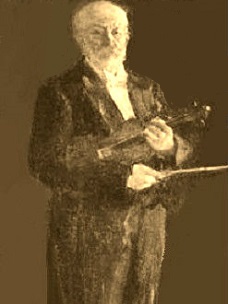
Jan Hrimaly was a Czech violinist and teacher born (in Pilsen, Hungary)
on April 13, 1844. He is known for
having written a Scale Study book which is still in use today. He is unusual in that he spent the major part
of his career in Russia – in fact, once he established himself in Moscow, he
never returned to his native country.
His father was an organist and composer and his first teacher was
probably an older brother - Vojtech. All
of Hrimaly’s other brothers and sisters were musicians as well. It has been said that he and three of his
brothers actually founded the very first string quartet in Czechoslovakia. It had to have been prior to 1861. Hrimaly enrolled at the Prague Conservatory
in 1855 at age 11. His violin teacher
there was probably Moritz Mildner.
Hrimaly graduated in 1861 and quickly became concertmaster of an
orchestra in Amsterdam. Nobody seems to
know which orchestra. He was 18 years
old. He was there for four years. At age 23, he was appointed violin teacher
at the Moscow Conservatory. He then took
over as violin professor for his father-in-law, Ferdinand Laub, in 1874. He was 30 years old. Hrimaly remained at the conservatory until
the year of his death – 46 years. That
is probably one of the longest tenures of all time, if not the longest. In 1874, 1876, and 1882, he took part in
premiering Tchaikovsky’s second and third string quartets and piano trio, in
that order. Between 1874 and 1906, he
was also concertmaster of the Russian Musical Society Orchestra in Moscow,
although I don’t know what that is or was.
It can be assumed he was an outstanding teacher since he lasted so long
at his teaching post. His students
include Paul Juon, Josif Kotek, Reinhold Gliere, Stanislaw Barcewicz, Alexander
Petschnikov, Julius Conus, Michael Press, and Peter Stolyarsky. Hrimaly
died on January 24, 1915, in Moscow, at age 70.
Were it not for his scale study book, he would likely be quite
(unjustly) forgotten.
Tuesday, January 5, 2010
Josef Suk
 Josef Suk was a Czech violinist, composer, and teacher born on January 4, 1874 (Brahms was 41 years old.) He is famous for having married one of Antonin Dvorak's daughters and for being the grandfather of violinist Josef Suk (whose micro biography is on this blog for August, 2009.) From 1885 until 1892, he studied at the Prague Conservatory, where he was a pupil of Antonin Dvorak, among others. He formed the Czech Quartet and played second violin with the quartet for most of his life. From 1922 he taught at the Prague Conservatory where his pupils included Bohuslav Martinu (composer) and Rudolf Firkusny (pianist-conductor.) His compositions include much chamber music and a few large-scale works. His second symphony (Opus 27 - 1905) was recorded by the Czech Philharmonic in 1952 and the recording is still available. His last composition (Sousedska, 1935) was a piece for five violins, bass, cymbals, triangle, side drum, and bass drum. Suk died on May 29, 1935, at age 61.
Monday, August 24, 2009
Vasa Prihoda
 Vasa Prihoda was a Czech violinist born on August 24 (or 22nd), 1900 (Stravinsky was 18 years old.) His father, Alois Prihoda, was his first teacher and remained so for ten years. Afterward, Prihoda attended the Prague Conservatory, where he studied with Marak (who himself studied with Otakar Sevcik.) He graduated in 1912 and gave his first public performance playing Mozart’s fourth violin concerto (D Major.) Most violinists choose Brahms, Mendelssohn, or Paganini for a debut, but not Prihoda. It has been said that Toscanini discovered him playing in a Café (Grande Italia) in Milan, Italy, on December 27, 1919. Prihoda is remembered for his prodigious technique (which included exceptionally clear articulation), his ease in playing Paganini showpieces, and his 1930 marriage to (and 1935 divorce from) violinist Alma Rose (Gustav Mahler’s niece.) [In 1944, Alma, whose father had been concertmaster of the Vienna Philharmonic for 50 years, died in a concentration camp.] After the war, Prihoda was censured by the Czech government because he did not boycott any of the German-occupied territories during the war. Prihoda concertized extensively all over the world and made a number of recordings when the industry was in its infancy. Unfortunately, some of his recordings were not well-produced so the sound quality is poor. He played in the U.S. many times and was greatly admired for his style, dazzling technique, and finesse. Critics have suggested that Heifetz was jealous of him. Vienna was his base of operations for many years though he taught in Prague, Munich, and Salzburg as well. After 1950, he dedicated most of his time to teaching and he also composed small chamber works which are no longer played. Prihoda also composed his own cadenzas to all the concertos he played. He gave his last concerts in April, 1960 and died (of heart disease) on July 26, 1960, at age 59 - Heifetz would live another 27 years. There are many amazing sound files and videos of his posted on YouTube.
Friday, August 7, 2009
Josef Suk
 Josef Suk was a Czech violinist, violist, and conductor born on August 8, 1929 (Heifetz was 28 years old and would live an additional 58.) He is descended from two highly distinguished musicians – his grandfather, the violinist-composer Josef Suk, and his great grandfather, Antonin Dvorak. In Czechoslovakia, he was given the title of National Artist. His concert appearances in the U.S. were few and far between. He is well-known for having favored chamber music over solo playing. At the Prague Conservatory, his teacher (up to 1950) was Jaroslav Kocian. He also studied at the Prague Academy. While still a student, he joined the Prague Quartet as first violinist. In 1951, he formed the Suk Trio with cellist Janos Starker and pianist Julius Katchen (some sources say it was cellist Josef Chuchro and pianist Jan Panenka because the trio was initially begun with these artists.) His solo debut in Prague took place in 1954 and was very successful. It has been said that his worldwide tour with the Czech Philharmonic in 1959 was especially memorable. Suk recorded extensively for various labels – EMI, Decca, Naxos, and Supraphon, among others. Suk won the Grand Prix Du Disque several times – for recordings of music by Claude Debussy, Leos Janacek, Alban Berg, and others. He was once asked why he did not compose like his grandfather and great-grandfather - he said the following: "To be a composer after Dvorak and after Suk, I would have to be sensational. I don't have that sort of inspiration. I tried, but it wasn't that good so I stayed with my fiddle." He also founded the Suk Chamber Orchestra in 1974. Suk retired in 2004, at age 74, but, like Heifetz, did play afterward now and then. He even recorded in the year 2010. He was 80 years old. Suk played a 1729 Stradivarius, a 1744 Guarnerius, and a 1758 Guadagnini. There are many videos of his playing on YouTube. Josef Suk died on July 6, 2011, at age 81.
Sunday, July 5, 2009
Jan Kubelik
 Jan Kubelík was a Czech violinist and composer born on July 5, 1880 (Brahms was 47 years old.) His first lessons were with his father, who was an amateur violinist. At age 8, he entered the Prague Conservatory where he studied with Otakar Sevcik. He began concertizing ten years later (1898), the same year he graduated from the Conservatory. Along with Joseph Joachim and Pablo De Sarasate, he was one of the first violinists to be recorded in the early 1900s. Following debuts in Vienna and London in 1900 and 1901, he toured the U.S. for the first time in 1901, starting out in Carnegie Hall on December 2, 1901. At that first U.S. concert, Kubelik was criticized for being a mere showman. However, he enjoyed great financial success everywhere he went. He was a society darling and was already wealthy in his mid-twenties. Carl Sandburg even titled a poem after him. In the latter part of his career, he played the Emperor Stradivarius (1715.) In 1903, Kubelik married Countess Marianne Czáky Szell and eventually became the father of (among others) conductor Rafael Kubelik. As late as 1930, he was still being hailed as the best-known name in the violinist world. Kubelík also wrote music, including six violin concertos which are now never played, and cadenzas for the violin concertos of Brahms, Beethoven, Paganini, and Mozart. A number of his recordings are posted on YouTube. Jan Kubelík died in Prague on December 5, 1940, having never actually retired.
Subscribe to:
Posts (Atom)