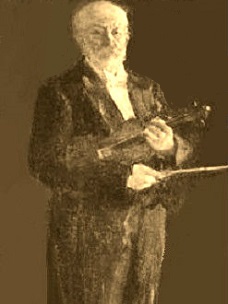
Edouard Colonne (Edouard Juda Colonne) was a French
violinist and conductor born (in Bordeaux) on July 23, 1838. He is best recognized as the founder
(actually, co-founder) of the Concerts Colonne and what became known as the
Colonne Orchestra in Paris, in 1873. He
was an orchestral violinist for at least ten years but is now almost
exclusively remembered as a conductor and concert promoter, in the style of
Theodore Thomas. He began his music
studies at age 8, but not on the violin.
He entered the Paris Conservatory at about age 17 but did not study with
any famous teachers there. While going
to school, he played in the orchestra of the Lyric Theatre. In 1863 he won first prize for his violin
playing and had already (in 1858) won first prize in harmony. He was engaged as concertmaster for the Paris
Opera orchestra in 1858 – he was 20 years old.
He also played second violin in the Lamoureux Quartet at the same time –
Charles Lamoureux played first violin. Possibly
(actually, very probably) simultaneously, he also played in Jules Pasdeloup’s
orchestra. In 1867, he came to New York
to play in an orchestra for a newly founded comic opera company; while in New
York, Colonne later led an ensemble called Niblo’s Garden Orchestra which until
now I had never heard of. He returned to
Paris in 1871 and conducted a hotel orchestra for a while. In 1873, he founded – together with a music
publisher – the orchestra that would become the Colonne Orchestra. His concerts became known as the Concerts
Colonne. This name was used until the
1960s – about ninety years. At first,
the orchestra presented its concerts at the Odeon Theatre and later at the
Theatre of the Chatelet. Colonne was
known to champion the music of Hector Berlioz, Richard Wagner, Gustav Mahler,
and Camille Saint Saens. It has been
said that Pierre Monteux was Principal violist of the Colonne Orchestra. Other famous players who played in his
orchestra for a time were Julius Conus and Jacques Thibaud. Colonne gave the Paris premiere of
Tchaikovsky’s fourth symphony in 1878, the year it was completed. The orchestra toured Spain, Russia, Portugal,
Germany, and England. Among the musical luminaries who conducted the orchestra in performances of their own works were Serge Prokofiev, Gustav Mahler, Richard Strauss, Peter Tchaikovsky, Claude Debussy, Edvard Grieg, and Maurice Ravel. In 1892, Colonne became
conductor and adviser at the Paris Opera.
He was 54 years old. In 1907 (one
source says 1906), he was one of the first to record with an orchestra. It has been said that he was hard on his
players. Colonne was a pioneer in that
his program books were the first to include program notes. Perhaps they included advertisements as well
though I’m not at all sure about that. He
died (in Paris) on March 28, 1910, at age 71.
Showing posts with label Julius Conus. Show all posts
Sunday, October 13, 2013
Sunday, September 22, 2013
Favorite Performances
This is a list of my favorite
performances or recordings of the standard violin concerto repertoire, and
perhaps a couple that are not yet so standard.
The word “favorite” does not necessarily mean “best,” it just means the
one I enjoy the most or the one that speaks to me best or the one I favor for
reasons I can’t readily explain. Just as
are my choices of violinists who are profiled here, the list is completely
arbitrary. You will notice that Heifetz
figures somewhat prominently and perhaps he would have been named even more
times but there are many concertos which he – to the best of my knowledge -
never recorded: the Barber, Berg, Dvorak, Haydn, Khachaturian, Mendelssohn 1,
Saint Saens 3, Schoenberg, Schumann (!!!), Shostakovich, Stravinsky, and
Vivaldi. Heifetz is named 12 times;
Isaac Stern is named 1 time, Gil Shaham is named 2 times; Michael Rabin is named 2 times; all the rest only
once. Not counting Vivaldi, there are 42 concertos included. I also threw in a few concert favorites which are not concertos but are very frequently played.
Actor Pip Clarke
Bach 1 Vladimir Spivakov
Bach 2 Isabelle Faust
Barber Elmar Oliveira
Beethoven Arabella Steinbacher
Berg Ivry Gitlis
Brahms Jascha Heifetz
Bruch 1 Isaac
Stern
Bruch 2 Jascha
Heifetz
Conus Jascha
Heifetz
Dvorak Joseph
Suk
Elgar
Jascha Heifetz
Glazunov Ilya Kaler
Haydn 1 Judith Ingolfsson
Khachaturian Leonid
Kogan
Korngold Jascha
Heifetz
Lalo 2 Joshua Bell
Mendelssohn 1 Yehudi
Menuhin
Mendelssohn 2 Gil
Shaham
Mozart 3 Arthur Grumiaux
Mozart 4 JuliaFischer
Mozart 5 Jascha
Heifetz
Paganini 1 Michael
Rabin
Paganini 2 Tedi
Papavrami
Paganini 3 Henryk
Szeryng
Paganini 4 Uto Ughi
Paganini 5
Salvatore Accardo
Prokofiev 1 Jascha Heifetz
Prokofiev 2 Jascha
Heifetz
Saint Saens 3 Zino Francescatti
Schoenberg Zvi Zeitlin
Schumann Frank Zimmermann
Shostakovich 1 Leonid
Kogan
Shostakovich 2 Itzhak Perlman
Sibelius Jascha Heifetz
Stravinsky Hilary Hahn
Tchaikovsky Tossy Spivakovsky
Vieuxtemps 4 Jascha Heifetz
Vieuxtemps 5 Jascha Heifetz
Vivaldi 1-50 Fabio
Biondi
Vivaldi 50-100 Giuliano
Carmignola
Vivaldi 100-150 Simon
Standage
Vivaldi 150-200 Enrico Onofri
Walton Jascha Heifetz
Wieniawski I Gil Shaham
Wieniawski II Michael
Rabin
Zigeunerweisen Joseph Lendvay
Zigeunerweisen Arthur Grumiaux
Zigeunerweisen Mischa Elman
Zigeunerweisen Arthur Grumiaux
Zigeunerweisen Mischa Elman
Zigeunerweisen Leila Josefowicz
Tzigane Jascha Heifetz
Poeme Jascha Heifetz
Rondo Capriccioso Leila Josefowicz
Bach Chaconne Viktoria Mullova
Sunday, March 17, 2013
Jan Hrimaly
Jan Hrimaly was a Czech violinist and teacher born (in Pilsen, Hungary)
on April 13, 1844. He is known for
having written a Scale Study book which is still in use today. He is unusual in that he spent the major part
of his career in Russia – in fact, once he established himself in Moscow, he
never returned to his native country.
His father was an organist and composer and his first teacher was
probably an older brother - Vojtech. All
of Hrimaly’s other brothers and sisters were musicians as well. It has been said that he and three of his
brothers actually founded the very first string quartet in Czechoslovakia. It had to have been prior to 1861. Hrimaly enrolled at the Prague Conservatory
in 1855 at age 11. His violin teacher
there was probably Moritz Mildner.
Hrimaly graduated in 1861 and quickly became concertmaster of an
orchestra in Amsterdam. Nobody seems to
know which orchestra. He was 18 years
old. He was there for four years. At age 23, he was appointed violin teacher
at the Moscow Conservatory. He then took
over as violin professor for his father-in-law, Ferdinand Laub, in 1874. He was 30 years old. Hrimaly remained at the conservatory until
the year of his death – 46 years. That
is probably one of the longest tenures of all time, if not the longest. In 1874, 1876, and 1882, he took part in
premiering Tchaikovsky’s second and third string quartets and piano trio, in
that order. Between 1874 and 1906, he
was also concertmaster of the Russian Musical Society Orchestra in Moscow,
although I don’t know what that is or was.
It can be assumed he was an outstanding teacher since he lasted so long
at his teaching post. His students
include Paul Juon, Josif Kotek, Reinhold Gliere, Stanislaw Barcewicz, Alexander
Petschnikov, Julius Conus, Michael Press, and Peter Stolyarsky. Hrimaly
died on January 24, 1915, in Moscow, at age 70.
Were it not for his scale study book, he would likely be quite
(unjustly) forgotten.
Sunday, May 22, 2011
Joseph Lambert Massart
Joseph Lambert Massart was a Belgian violinist and teacher born (in Liege) on July 19, 1811 (Paganini was 29 years old and would live another 29.) He performed as a soloist only infrequently and devoted most of his time to teaching. As a young student, because he was not admitted to the Paris Conservatory (because he was a foreigner), he took private lessons with Rodolphe Kreutzer. Luigi Cherubini (the Italian composer) was the Conservatory Director at the time. Paradoxically, at age 32, he was accepted as a Professor at the same Conservatory (1843.) He then taught there for 47 years. Massart performed Beethoven's Kreutzer Sonata with none other than Franz Liszt – his teacher had previously rejected it as unintelligible. Among Massart’s students were legendary violinists Isidor Lotto, Fritz Kreisler, Franz Reis, Eugene Ysaye, Pablo Sarasate, Julius Conus, Teresina Tua, Arma Senkrah, and Henryk Wieniawski. When one teaches for forty seven years, one is bound to find at least a few good students. Among this group, Pablo Sarasate and Fritz Kreisler are the only ones who produced no extraordinary students although, to be fair, Kreisler did teach Samuel Dushkin, the violinist who premiered Stravinsky's violin concerto. Massart has been credited with the origination of the systematic vibrato. This is his claim to fame, since he is not among the trio of violinists who earlier established the violin method taught at the Paris Conservatory – Rode, Baillot, and Kreutzer. It has been conjectured that Kreisler championed such a system, though it was widely criticized at the time, being considered a little too emotive and perhaps even vulgar. Massart was also a chamber music player and gave many concerts with his wife (Louise Aglae Marson), who was a pianist. He died in Paris on February 13, 1892, at age 80. Other than in connection with his famous pupils, his name is infrequently mentioned nowadays.
Saturday, October 23, 2010
Maud Powell
Maud Powell was an American violinist, writer, and arranger born on August 22, 1867 (Brahms was 34 years old.) She is remembered for having been a concert violinist at a time when women violinists – even among orchestral players - were a rarity. Her career was spent almost exclusively in the U.S. Her first violin studies began when she was seven. At age 9 she became a pupil of William Lewis in Chicago. She then began playing in and was soon made assistant concertmaster of the Aurora (Illinois) Symphony Orchestra. Her debut as soloist with this orchestra took place in 1880. She further studied in Europe with Henry Schradieck in Leipzig (1881-1882) and Charles Dancla in Paris (1882-1883.) She spent a year intermittently concertizing in London and then studied briefly with Joseph Joachim (1884-1885) who conducted the orchestra when she gave her Berlin debut with the Berlin Philharmonic in March of 1885 playing the Bruch g minor concerto. Returning to the U.S., she gave her New York debut with the New York Philharmonic on November 14, 1885 again playing Bruch’s first concerto. She was then eighteen years old. She soon began including works by contemporary American composers in her programs, including Arthur Foote, Henry Huss, Victor Herbert, and John Carpenter. She gave the American premieres of the Tchaikovsky and Sibelius concertos. Her fan club claims she premiered the Dvorak concerto as well but that is not true. Max Bendix premiered the Dvorak concerto with the Chicago Symphony on October 30, 1891. Powell gave the first New York performance of the concerto in 1893 but that's all. Mastering a very extensive repertoire, Powell also frequently played the concertos of Saint Saenz, Lalo, Arensky, Conus, and Rimsky Korsakov, among others. Her premiere of the Sibelius concerto on November 30, 1906 was especially significant although this concerto did not enter the standard violin repertoire until after Jascha Heifetz championed it. Powell founded a quartet in 1894 and a trio in 1908. She frequently wrote her own program notes and wrote numerous articles for music journals. I don’t know if she ever took students. Among her many violins was a supposed JB Guadagnini (1775) which was later sold to Henry Ford, the car maker. The Guadagnini was later declared (by Kenneth Warren) to actually be a copy made by New York Luthier George Gemunder on or about 1865. (She had purchased - around 1886 - a violin from a dealer named Victor S. Flechter which turned out to be a fake. Powell later sued the dealer because she had paid $500 and the violin was said to be worth only $40. The violin had supposedly been made by Gaspard Duiffoprugcar in 1515.) Powell also owned a Guarneri from 1731, the Mayseder Guarneri. She did a lot of recording for RCA during the industry’s infancy (1904-1907). YouTube has postings of a few of her recordings. Maud Powell died (in Uniontown, Pennsylvania) on January 8, 1920, at age 52, while preparing for a concert. Tuesday, November 3, 2009
Julius Conus
Julius Conus (Juli Eduardowitsch Conyus or Konius) was a French violinist and composer born on February 1, 1869 (Brahms was 36 years old.) He was actually born in Moscow since his family had migrated to Russia in the early 1800s. Today, he is remembered for his violin concerto in e minor, although he wrote other music, though not much. He studied violin with Jean (Jan) Hrimaly (a Czech violinist) at the Moscow Conservatory and received the gold medal in 1888. At the same time, he studied composition with Tchaikovsky. Afterward, he studied in Paris (with Joseph Lambert Massart) and played in the opera orchestra and in Edouard Colonne's Orchestra as well. He was concertmaster of the New York Philharmonic from 1891 until 1893. He returned to Moscow in 1893 to teach at the Conservatory, concertize as a soloist, and play in chamber music ensembles. One of his students was Ivan Galamian. He premiered his popular violin concerto in 1898. He had been working on it since 1896 and he dedicated it to his teacher, Jean Hrimaly. Fritz Kreisler and Jascha Heifetz both championed the concerto, though critics never liked it. Conus moved out of Russia again in 1919, establishing himself in Paris and teaching at the Russian Conservatory there until 1939. In that year, Conus returned to Moscow where he lived out the rest of his life. He was 70 years old. It has been said that the Russian government refused him an exit visa and starved him to death because he refused to join the Communist Party, putting out a decree that anyone helping him by offering him food or shelter would be imprisoned. He supposedly died on the streets of Moscow on January 3, 1942, at age 73. Nobody intervened to save him - however, all of this is hard to believe because he was still a French citizen when he died. Monday, February 2, 2009
Jascha Heifetz
Jascha Heifetz was a Russian (Lithuanian) violinist, composer, and teacher born on this day (February 2) in 1901 - some sources say January 20, 1901. He has often been called the greatest violinist of the Twentieth Century. After Paganini, he is probably the most famous violinist who ever lived. Ironically, he did not record any of the Paganini concertos. He first took lessons – at age three - from his father (Ruben, concertmaster of the Vilna Symphony Orchestra), and then began lessons at age five with Ilya Malkin. He first played in public at age 7. At age 9 he entered the St Petersburg Conservatory to study under Leopold Auer. While still a very young student, he toured much of Europe, playing with the Berlin Philharmonic as a 13-year-old. His first performance with the Berlin Philharmonic occurred on October 12, 1912. He played the Tchaikovsky concerto on that occasion. Arthur Nikisch was on the podium. On January 4, 1933, he played the 5th concerto by Mozart, the Beethoven concerto, and the Brahms concerto on the same program. He was 31 years old. He did not set foot in Germany ever again. A few violinists have played two concertos on the same program and even fewer have played three concertos on the same program. Until recently, I did not know that Heifetz had done the same thing. Heifetz came to the U.S in 1917 and debuted in Carnegie Hall on October 17, 1917, still only sixteen years old. His concertizing and recording career took off after that. Eddy Brown stated afterward that Heifetz made everyone else, including Kreisler, sound like students. Heifetz composed a very small quantity of original music but made many arrangements and transcriptions which are still in wide use. He is probably the most recorded violinist of all time, although Louis Kaufman and Ruggiero Ricci biographers claim the same thing about Ricci and Kaufman. Heifetz taught for many years at UCLA and USC (both in Southern California, U.S.A.). Two of his famous pupils were Erick Friedman and Eugene Fodor. He played the famous Dolphin Stradivarius (1714), a 1742 Guarneri, a 1731 Stradivarius, a 1734 Stradivarius, and a 1736 Carlo Tononi violin. Heifetz died on December 10, 1987, at age 86.
Subscribe to:
Posts (Atom)