 Hugo Heermann was a
German violinist and teacher born (in Heilbronn) on March 3, 1844. He taught briefly in the U.S. but spent most
of his teaching career in Frankfurt, at the well-known Hoch Conservatory. He taught there for 25 years - from 1878
until 1904 – but also concertized sporadically.
Joseph Lambert Massart and Joseph Joachim were among his teachers. At 20 years of age (1864), he established
himself in Frankfurt. Beginning in 1865,
he played first violin in the Heermann Quartet (which also used other names) with
Fritz Bassermann on second, Adolf Rebner on viola, and Hugo Becker on cello. As mentioned previously, he became a teacher
at the Hoch Conservatory in 1878. His
most famous pupil at the conservatory (by far) is Bronislaw Huberman – that
fact alone is sufficient to keep his name in the music history books forever. In the early 1900s Heermann came to the U.S.
and played the Beethoven concerto in his first U.S. appearance on February 5,
1903. I don’t know which orchestra
accompanied him but I do know he played a cadenza he composed himself. He very soon after played the Brahms concerto
with the New York Philharmonic on February 13, 1903 and received very favorable
reviews. It is said to be the first New
York performance of the concerto. Walter
Damrosch was on the podium so it was probably the New York Symphony which he
played with, although it was later merged with what we now know as the New York
Philharmonic. Franz Kneisel had already
played the first Boston performance – possibly the first U.S. performance of
the Brahms concerto - on December 6, 1889.
On April 3 of the same year Heermann played the first Bruch concerto
with the philharmonic under the same conductor.
His final appearance with the philharmonic was on January 26, 1907 – by
then, he had already settled in the U.S.
He played the Beethoven concerto on that occasion. A critic pointed out that he had made a “deep
impression upon the audience, and was rewarded with all the enthusiastic
applause which his performance warranted, being recalled again and again.” Heermann taught at the Chicago Musical
College from 1906 to 1909. He was later
appointed concertmaster of the Cincinnati Symphony, where he served between
1909 and 1911. In 1911, he returned to
Europe, taking up teaching; first at the Stern Conservatory in Berlin, and,
beginning in 1912, at the Music Conservatory in Geneva, Switzerland. For many years, Heermann used a 1733
Stradivarius violin which he purchased in 1860.
On or about the year 1888, Heermann acquired another Stradivarius violin
presumably made in 1734. That violin was
purchased by Eugene Ysaye in 1895, from whom it was stolen in 1908. After it was found in a Paris shop in 1925,
none other than (violinist) Charles Munch bought it and kept it until
1960. It was later played by Henryk
Szeryng, who bequeathed it (in 1972) to the City of Jerusalem, to be used by
the concertmaster of the Israel Philharmonic.
The violin goes by various names but that does not make it hard to
trace. Another Stradivarius which
Heermann used and which was constructed in (about) 1734, is now played by Gidon
Kremer. That violin is known as the
Heermann Stradivarius. Heermann also used
yet another Stradivarius violin (from about 1700 - the Jupiter Strad) from 1892
to 1895. According to the Cozio website,
that violin is now in the hands of Hollywood studio violinist Arnold
Belnick. Heermann retired in 1922,
living mostly in Merano, Italy, where he eventually died on November 6, 1935,
at age 91.
Showing posts with label New York Symphony. Show all posts
Showing posts with label New York Symphony. Show all posts
Sunday, July 28, 2013
Hugo Heermann
Hugo Heermann was a
German violinist and teacher born (in Heilbronn) on March 3, 1844. He taught briefly in the U.S. but spent most
of his teaching career in Frankfurt, at the well-known Hoch Conservatory. He taught there for 25 years - from 1878
until 1904 – but also concertized sporadically.
Joseph Lambert Massart and Joseph Joachim were among his teachers. At 20 years of age (1864), he established
himself in Frankfurt. Beginning in 1865,
he played first violin in the Heermann Quartet (which also used other names) with
Fritz Bassermann on second, Adolf Rebner on viola, and Hugo Becker on cello. As mentioned previously, he became a teacher
at the Hoch Conservatory in 1878. His
most famous pupil at the conservatory (by far) is Bronislaw Huberman – that
fact alone is sufficient to keep his name in the music history books forever. In the early 1900s Heermann came to the U.S.
and played the Beethoven concerto in his first U.S. appearance on February 5,
1903. I don’t know which orchestra
accompanied him but I do know he played a cadenza he composed himself. He very soon after played the Brahms concerto
with the New York Philharmonic on February 13, 1903 and received very favorable
reviews. It is said to be the first New
York performance of the concerto. Walter
Damrosch was on the podium so it was probably the New York Symphony which he
played with, although it was later merged with what we now know as the New York
Philharmonic. Franz Kneisel had already
played the first Boston performance – possibly the first U.S. performance of
the Brahms concerto - on December 6, 1889.
On April 3 of the same year Heermann played the first Bruch concerto
with the philharmonic under the same conductor.
His final appearance with the philharmonic was on January 26, 1907 – by
then, he had already settled in the U.S.
He played the Beethoven concerto on that occasion. A critic pointed out that he had made a “deep
impression upon the audience, and was rewarded with all the enthusiastic
applause which his performance warranted, being recalled again and again.” Heermann taught at the Chicago Musical
College from 1906 to 1909. He was later
appointed concertmaster of the Cincinnati Symphony, where he served between
1909 and 1911. In 1911, he returned to
Europe, taking up teaching; first at the Stern Conservatory in Berlin, and,
beginning in 1912, at the Music Conservatory in Geneva, Switzerland. For many years, Heermann used a 1733
Stradivarius violin which he purchased in 1860.
On or about the year 1888, Heermann acquired another Stradivarius violin
presumably made in 1734. That violin was
purchased by Eugene Ysaye in 1895, from whom it was stolen in 1908. After it was found in a Paris shop in 1925,
none other than (violinist) Charles Munch bought it and kept it until
1960. It was later played by Henryk
Szeryng, who bequeathed it (in 1972) to the City of Jerusalem, to be used by
the concertmaster of the Israel Philharmonic.
The violin goes by various names but that does not make it hard to
trace. Another Stradivarius which
Heermann used and which was constructed in (about) 1734, is now played by Gidon
Kremer. That violin is known as the
Heermann Stradivarius. Heermann also used
yet another Stradivarius violin (from about 1700 - the Jupiter Strad) from 1892
to 1895. According to the Cozio website,
that violin is now in the hands of Hollywood studio violinist Arnold
Belnick. Heermann retired in 1922,
living mostly in Merano, Italy, where he eventually died on November 6, 1935,
at age 91. 
Sunday, June 30, 2013
Charles Loeffler

Charles
Loeffler (Charles Martin Loeffler) was a German violinist, composer, and
teacher born (in Schoneberg, Germany – the outskirts of Berlin) on January 30,
1861. While claiming to be French
(Alsatian), he spent most of his career in the U.S. and rose to prominence
before being almost forgotten. He was
resentful toward his native Germany because his father had been imprisoned for
being on the wrong political side of things and died in prison. Not unlike violinist Nicolai Berezowsky many
years later, he was considered a major composer in his day but gradually fell
out of favor. Many music critics called
him one of America’s greatest composers.
He began his violin studies at about age 9, in 1870. Several sources state that he entered the
Advanced School for Music in Berlin at age 13, that is, 1874. There, he studied with Joseph Joachim and Edouard
Rappoldi. Composition he studied with
Clara Schumann’s half-brother, Woldemar Bargiel. After three years, he traveled to France
where he further studied (presumably at the Paris Conservatory) - violin with
Joseph Lambert Massart (pupil of Rodolphe Kreutzer) and composition with Ernest
Guiraud, teacher also of Claude Debussy.
Loeffler played in the famous Pasdeloup Orchestra and later on (1979 to
1881) in a private orchestra engaged by Paul von Derwies. Cesar Thomson also played in this private
orchestra although he was not there by the time Loeffler arrived. Loeffler was 20 years old when he left for
the U.S. One source states Loeffler set
foot in the U.S. on July 27, 1881. By
then, he had already lived in Germany, France, Russia, Hungary, and
Switzerland. He soon got a job playing
in the New York Symphony. He also played
in orchestras put together for occasional concerts by Theodore Thomas. In 1882, he was engaged by the Boston
Symphony, where he was assistant concertmaster for over twenty years. Franz Kneisel was concertmaster during most
of those years (1885-1903.) Loeffler
played with the orchestra until 1903. His first appearance as soloist with the
Boston Symphony took place on November 20, 1891. He played one of his own works, his first
orchestral composition. His works were
often played by American Orchestras during his lifetime. In 1905, none other than violinist Karl Halir
and composer Richard Strauss presented one of his works for violin and
orchestra in Berlin. It has been said
that Loeffler was a very careful and conscientious composer. Here is one example of a chamber music
work. His music has been described as
eclectic, influenced by the Symbolist movement.
He even wrote music for jazz band, possibly the first classical composer
to do so. His most famous work is
something called A Pagan Poem. Opinions vary, of course, but in my estimation, this work is worthy of being included in the repertoire of every orchestra in the world. As far as I know, the Pagan Poem has only been recorded 3 times. As did violinist
Richard Burgin much later, Loeffler frequently traveled to France and other parts of
Europe. After leaving the Boston
Symphony, he was very active not only composing but in various musical
endeavors. He was on the Board of
Directors of the Boston Opera Company at its inception in 1908. He was instrumental in establishing the
Juilliard School of Music in New York in 1924.
Other composers dedicated works to him.
He lived long enough to count George Gershwin among his friends. After his death, his manuscripts and
correspondence went to the Library of Congress.
The rest of his possessions went to the French Academy and the Paris
Conservatory. His best-known students are
probably Arthur Hartmann and Katherine Swift (George Gershwin’s lover.) Loeffler died (in Medfield, Massachusetts) on
May 19, 1935, at age 74. Among other
violins, Loeffler played a JB Vuillaume from (about) 1840 and a 1710
Stradivarius now known as the Duc De Camposelice or Camposelice for short. He used the violin between 1894 and 1928, at
which time it was returned to its Boston owner.
That Stradivarius was later owned by Vasa Prihoda, husband of Austrian
violinist Alma Rose for a time, and then eventually ended up with the Nippon
Foundation until it was sold at auction in 2006.
Sunday, June 23, 2013
Scipione Guidi

Scipione Guidi was an Italian violinist born
(in Venice) on July 17, 1884. He is one
of many outstanding violinists who established themselves in Hollywood as
studio musicians – players such as Louis Kaufman, Israel Baker, Heimo Haitto,
Toscha Seidel, Felix Slatkin, Paul Shure, Eudice Shapiro, and Joseph
Achron. He is known among cognoscenti
and music specialists, especially because of his extraordinary recording of
Richard Strauss’ Ein Heldenleben tone poem, but most everyone else is not at
all familiar with him. The famous
recording was done in December of 1928 with the New York Philharmonic and
Willem Mengelberg, the conductor to whom Ein Heldenleben was dedicated. Between November, 1905 and January, 1929, Mengelberg
performed the Strauss work no fewer than 21 times with the philharmonic. Guidi was the soloist for almost all of these
performances. Guidi studied at the Royal
Conservatory in Milan. At what age he
began his studies is unknown to me. He
is said to have begun teaching at the same school later on. However, he soon moved to London where he
formed a trio. I do not know whether it
was a string or a piano trio. From
London he moved to New York. In New
York, he was hired (in 1919) as concertmaster for the National Symphony of New
York. He was 35 years old. In 1921, when the National Symphony of New
York was absorbed by the New York Philharmonic, he stayed on as
concertmaster. Willem Mengelberg had
been the conductor of the National Symphony and was then hired as conductor of
the restructured New York Philharmonic. Guidi
formed the New York Trio in 1919 (with Clarence Adler, piano, and Cornelius
Vliet, cello) but had to leave the trio in 1923 because he simply became too
busy with orchestral work. Louis Edlin took
his place as violinist. As far as I know,
Guidi first soloed with the New York Philharmonic on November 26, 1922, playing
Max Bruch’s Scottish Fantasy. Josef
Stransky conducted. Guidi went on to
appear at least 12 times as soloist with the orchestra. Among the works he played were Beethoven’s
concerto, Bruch’s g minor concerto, Mendelssohn’s second concerto, Saint Saens’
third concerto, Beethoven’s triple concerto, and Brahms’ double concerto (with
Alfred Wallenstein on cello.) In 1928,
the New York Philharmonic merged with the New York Symphony, another New York
orchestra. Guidi retained his post as
concertmaster. In 1931, one year after
the ill-tempered Arturo Toscanini took over the orchestra as permanent
conductor, Guidi moved to St Louis. He
was 47 years old. In St Louis, Guidi served
as concertmaster of the St Louis Symphony, under conductor Vladimir Golschmann. On December 7, 1934, Guidi played the Sibelius concerto with the orchestra, with Golschmann conducting. That was the first performance of the concerto in St Louis. American violinist Maud Powell had premiered the Sibelius concerto on November 30, 1906 - apparently, it took 28 years for the work to travel from New York to St Louis. It has been said that it was Golschmann who
recruited Guidi for the concertmaster job. It has also
been said that Golschmann later fired him in the middle of a rehearsal in 1942, during a disagreement about how a passage should be played. Guidi went to Los Angeles after losing his
job in St Louis and played in Hollywood studio orchestras. He also became conductor of the Glendale
Symphony. After Guidi passed away, his
spacious home just off Sunset Boulevard was purchased by harmonica virtuoso, George
Fields. Later on, for almost two years, Fields
used part of the house as his personal recording studio. He said Guidi’s inscribed photos of many of
his famous colleagues on the walls of his study – Bruno Walter, Jascha Heifetz, Antal Dorati, Igor Stravinsky, Pablo Casals, Arturo
Toscanini, Yehudi Menuhin, Fritz Reiner, Wanda Landowska, Wilhelm Backhaus, Willem Mengelberg, Walter Damrosch, Vladimir
Horowitz, and Wilhelm Furtwangler among others - were “formidably
inspiring.” Among Guidi’s violins was a
1772 Guadagnini, purchased in 1930. Guidi
died (in Los Angeles) on July 7, 1966, at (almost) age 82. His Guadagnini is now very valuable but I do
not know what became of it.
Sunday, August 19, 2012
Mischa Mischakoff

Thursday, February 16, 2012
Calvin Sieb
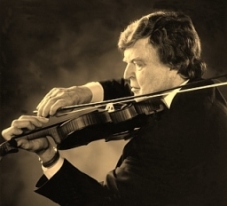
Calvin Sieb was an American violinist and teacher born (in Newark, New Jersey) on May 30, 1925. He is known for having spent most of his career in France and Canada. He started his violin studies at age five with Mandel Svet but in 1938, began his studies (privately) with Hans Letz, a well-known chamber music player and teacher of the time. He continued with Letz until 1943, the year he graduated from Columbia High School. He joined the U.S. Air Force in 1943 or 1944 and was discharged in 1945. From 1945 until 1948 he was at the Juilliard School, studying with Letz and (perhaps) Ivan Galamian. In 1949 and 1950, he studied with Emanuel Vardi, the famous violist, though at another music school. In 1950 he went to France to study with Jacques Thibaud in Paris. A year later, upon his return to New York, he accepted a position as violin professor at the Quebec Conservatory (1951-1956) and Assistant Conductor of the Quebec Symphony (1951-1953.) He was 25 years old. He was concertmaster of the CBC Symphony, with which he did a lot of studio work, from 1954 to 1958. He then became, in 1960, concertmaster of the Montreal Symphony, remaining with the orchestra until 1979. He was also an active recitalist and concert violinist during this time. In 1970, he became a naturalized Canadian citizen. While he played in the Montreal Symphony, he got to use the Laub Strad, purchased for the orchestra by John McConnell, a Canadian businessman. According to Sieb, the first American performance of the Tchaikovsky violin concerto was played in Chicago on this instrument. That is, of course, not true. That American premiere performance of the Tchaikovsky concerto was given in 1889 by Maud Powell and the New York Symphony, and not with this violin. In 1979, he relocated himself to France, where he became concertmaster of the orchestra in Toulouse. He came back to Canada in 1989 and was appointed professor at the University of Ottawa. He was 64 years old. He retired from this post in 2001. Somewhere along the way, he invented a mute and something called a violin chin rest pad. Sieb died on May 21, 2007, at age 81.
Wednesday, January 18, 2012
Elias Breeskin

Elias Breeskin was a Russian (Ukrainian) violinist, composer, arranger, teacher, and conductor born in 1896 – the exact date is unknown. One source gives his year of birth as 1897, but that source (Cozio) is usually messy and unreliable. He was a notorious gambler and con man who was a very successful musician in spite of his addiction to gambling. He began violin lessons very early in life and, according to one source, by age 7 was studying formally at a conservatory in Poland. He played in public at age 8 and was acclaimed. It has been said that he studied with Leopold Auer in Russia. Whether that is true is quite debatable. At age 10 (1906), he played for Franz Joseph, the Austrian Emperor. After this performance, the Emperor supposedly gave him a priceless ring right off his finger. That, too, is highly questionable. Soon after, the family came to the U.S. and settled in Washington D.C., a very odd place for a European musical family to settle – then and even now. Sponsored by a Washington benefactor, he may have first gone to Baltimore to study at the Peabody Conservatory. However, Breeskin himself stated that after securing financing from (among a few others) Frank Damrosch (brother of conductor Walter Damrosch and, at the time, Director of the Institute of Musical Arts which later became Juilliard), he began his American musical education at Juilliard (New York) in the spring of 1908. He studied with Franz Kneisel for about seven years. A magazine from that era (The Violinist) and the New York Times reported that Breeskin attended Columbia University after hours, studying languages and other subjects. Possibly upon graduation from Juilliard – in 1915 - he shared the Loeb Memorial Prize with Sascha Jacobsen. He was 19 years old. Afterward, as part of the Loeb Prize awarded him, he made his debut in Carnegie Hall and was very well received. In February or March of 1917, he received (on loan) a Stradivarius violin (the 1703 Rougemont Strad) and a Tourte bow from a benefactor – Edward Schafer – which he used for about ten years. In 1929, for understandable reasons, the violin was returned to the benefactor to help him with payment of debts after the stock market crash. The Rougemont was later played for two years by Jacques Gordon, concertmaster of the Chicago Symphony. I do not know where it is now. Breeskin joined the New York Symphony in 1917. At that time, this orchestra was being conducted by Walter Damrosch. Though it was organized many years after the New York Philharmonic, it was the first American orchestra to tour Europe - it merged with the Philharmonic in 1928. Among the New York Symphony’s members were Mischa Elman and Pablo Casals. In early February, 1917, Breeskin appeared in recital at the Aeolian Hall in New York City. A little over a year later (February 28, 1918), he played there again. One of the works he played at this second recital was Bruch’s second concerto with Lawrence Goodman at the piano. On April 1, 1919, he finally made his Carnegie Hall debut, a debut which for unknown reasons, had been postponed several times. Among the works he played was Lalo’s Symphonie Espagnol. This time, he was accompanied by pianist Josef Adler. He was very favorably received at each of his recitals. In June of 1920, he married into a very wealthy American family. Anyone else would have used these newly-acquired resources to become a very major and influential figure in music, but not Breeskin. He was about 24 years old. At about the same time, it became known that he was a serious gambler. Around this time, he also became concertmaster of the Capitol Theatre Orchestra in New York. He was named conductor of the Minneapolis Symphony in 1925. Because of his gambling habit and the consequent accumulation of gambling debts, that job did not last long. Having left Minneapolis within the year, he went to Pittsburgh where he helped re-organize the Pittsburgh Symphony. There, he was concertmaster and associate conductor. The gambling continued. His last year in Pittsburgh (1929-1930), he was named Principal Conductor. He left Pittsburgh after his divorce from his wealthy wife. I am guessing that up to this time, his wife’s family may have been taking care of his huge gambling debts. Then, he returned to New York. He worked as an orchestral musician and arranger for a few years. He did some recording as conductor of a pickup orchestra for the KBS (Keystone Broadcasting System) label. Those recordings may still be available though they mostly feature light classical or salon music. He also recorded several violin pieces with pianist Theodore Saidenberg for KBS, one of which can be found on YouTube. Breeskin may have also recorded for the RCA and Brunswick labels. Many years later (1937), he found himself in Hollywood. There, he wrote and arranged music and he helped form the Hollywood Bowl Symphony. Nevertheless, having at one point in 1940 stolen the orchestra’s payroll, he exited to Mexico City, where he worked as musical director for radio stations XEW, XEX, and XEB, gave lessons, and composed movie soundtracks. His second family later joined him. If it’s true that he studied languages at Columbia, those studies now came in handy. One source has it that he lived like a king, surrounded by servants. As far as I know, he never set foot in the U.S. again. In any case, his great success in Mexico lasted about five years. The gambling had continued and he was finally imprisoned for supposedly being on the wrong side of the political agenda – he may have been a Communist - and, presumably, for his gambling debts as well. He was pardoned in 1958. He was 62 years old. While in prison, he wrote a piece entitled the City of the Dead. It got good reviews when he premiered it later on. Whether it is still performed is anyone’s guess – I’m guessing it is not. He married for a third and final time after leaving prison. Breeskin died May 9, 1969, at about age 73. He left three wives (Adelyn, Anna, and Lena) and seven children.
Tuesday, May 12, 2009
Ottokar Novacek
 Ottokar Novacek (Ottokar Eugen Novacek) was a Czech (some would say Hungarian) violinist and composer born on May 13, 1866. He is best known for his Perpetual Motion for violin and piano (or orchestra). He studied first with his father (Martin Novacek) then with Jacob Dont, Henry Schradieck, and Adolf Brodsky. He played in the Gewandhaus Orchestra (Leipzig) and in the Brodsky Quartet (second violin and later, viola). When he came to the U.S., he played in the Boston Symphony (1891). In 1892, he was appointed Principal violist in the New York Symphony under Walter Damrosch. An illness forced him to soon retire and devote himself to composition. His works include a piano concerto, three string quartets, and many other pieces for violin and piano which are seldom played. There are many videos of different world famous violinists playing his Perpetual Motion on YouTube. One of them (with Nathan Milstein) is here. Novacek died (in New York City) on February 3, 1900, at age 33.
Subscribe to:
Posts (Atom)