Showing posts with label Emanuel Vardi. Show all posts

Sunday, December 29, 2013

Oscar Shumsky

Oscar Shumsky was a Russian (most people would say American) violinist, violist, conductor, and teacher born (in Philadelphia) on March 23, 1917.  He had a long and busy career during which he almost completely stopped concertizing in favor of teaching.  It has been said that Otokar Sevcik had over 5,000 students over the span of a greater-than sixty-year teaching career.  Shumsky had lots of students but I’m pretty sure it wasn’t more than five thousand.  It has also been said of Shumsky that he had an un-compromising, opinionated personality – in the style of Berl Senofsky.  Shumsky began to study the violin at age three - one source says age 4 - with Albert Meiff.  He first appeared with orchestra at age seven with the Philadelphia Orchestra and Leopold Stokowski on the podium, playing Mozart’s fifth concerto – known as the Turkish concerto.  At age 8 he began to study privately with Leopold Auer in New York.  Three years later (1928) he entered the Curtis Institute where he continued to study with Auer and later on (beginning in 1930) with Efrem Zimbalist.  He made his New York debut in 1934.  He was 17 years old.  He graduated from Curtis in 1936 but continued to study privately with Zimbalist until 1938.  He joined the NBC Symphony under the ill-tempered conductor Arturo Toscanini in 1939.  He was the youngest member of the orchestra and sat in the second stand of the first violins.  That same year, he also joined the Primrose Quartet as first violinist – William Primrose was also a member of the NBC Symphony.  At the time, many top-flight New York musicians had become members of either the NBC Symphony or the New York Philharmonic because solo work was scarce.  From 1941, he served in the Navy, playing as one of the orchestral soloists and playing in the Navy string quartet with cellist Bernard Greenhouse, violist Emanuel Vardi, and David Stone (please see comments below).  After the war, Shumsky was featured on weekly radio programs on NBC, as were a few other violinists of the time.  However, a very reliable source says that this broadcast activity actually occurred in 1939, before the war.  It may have been both, before and after.  Whether any of those programs survive in recordings is anybody’s guess.  Shumsky also worked as a studio musician, leading the RCA and the Columbia Symphonies as concertmaster on various occasions.  Shumsky taught at the Curtis Institute (1961 to 1965), the Peabody Conservatory (from 1942), Yale University (from 1975), and the Juilliard School (from 1953.)  I do not know how long he taught at each particular school.  On December 15, 1956, he appeared with the New York Philharmonic playing the Beethoven concerto.  Leonard Bernstein was on the podium.  Shumsky made his conducting debut in 1959.  As far as I know, he never conducted any major orchestras.  His commercial discography includes Rode’s 24 Caprices, Beethoven’s concerto, Brahms’ concerto, two Mozart concertos (4 and 5), three Bach concertos, the Glazunov concerto, the complete Mozart Sonatas, the complete Brahms Hungarian Dances, and the Bach solo Partitas and Sonatas.  He also recorded with the Primrose Quartet and those recordings are still available.  Here is a YouTube video of one of his recorded performances.  It is the famous Richard Strauss sonata – the one responsible for the attack on Jascha Heifetz (which resulted in his broken arm.)  Glenn Gould is the accompanist.  Shumsky’s students include Steven Staryk, Stanley Ritchie, Guillermo Figueroa, and Ida Kavafian.  Among many other violins, Shumsky played (and owned) the 1715 Stradivarius known as the Pierre Rode Stradivarius.  The violin was inherited by Shumsky’s two sons who sold it to Tokuji Munetsugu in 2004.  According to at least one source, this violin was subsequently played (at least for a while) by Ryu Goto, brother of the famous violinist, Midori.  Shumsky died (in New York) on July 24, 2000, at age 83.  

Friday, December 28, 2012

Daniel Guilet

Daniel Guilet (Guilevitch) was a Russian violinist (some would say French or American) born (in Rostov) on January 10, 1899.  Although he was for a few years concertmaster of the famous NBC Symphony under the ill-tempered Arturo Toscanini, he is better known as the original violinist and founder of the Beaux Arts Trio.  His parents moved from Russia to Paris before the turn of the century, and he later trained at the Paris Conservatory with George Enesco.  After graduation, he toured Europe as a recitalist with Maurice Ravel as his accompanist.  He also played second violin in the Calvet String Quartet (with Joseph Calvet, Leon Pascal, and Paul Mas.)  A YouTube audio file of one of their recordings can be found here.  Guilet came to the U.S. in 1941.  He was about 41 years old.  He soon formed a quartet (which at various times included Henry Siegl, Jac Godoretzky, William Schoen, Frank Brieff, David Soyer, and Lucien Laporte) under his own name.  A YouTube performance by this quartet can be heard here.  Three years later (1944) he joined the NBC Symphony.  Seven years after that (1951), he became its concertmaster and remained in that position after Toscanini retired in 1954, although the orchestra had to change its name – a string quartet from the NBC orchestra which included Emanuel Vardi and Daniel Guilet, used to play for the retired maestro at his home almost every Sunday in order to cheer him up.  In that same year (1954), Guilet formed the Beaux Arts Trio with pianist Menahem Pressler and cellist Bernard Greenhouse.  The trio gave its first concert on July 13, 1955 and its last on September 6, 2008.  Guilet retired from the trio in 1968 and from playing altogether (publicly) in 1969.  The trio (featuring Guilet) has a few audio files on YouTube although files and videos with subsequent violinists are more numerous.  One such audio file is here.  After his retirement, Guilet taught at Indiana University, the Manhattan School of Music, the Royal Conservatory in Canada (Montreal), Oklahoma University, and Baylor University (Waco, Texas.)  He owned a JB Vuillaume violin from 1867, a Carlo (or Michele Angelo) Bergonzi from 1743, and a 1727 Guarnerius Del Gesu which he got rid of in 1973 (after he retired from playing) and which passed through the hands – perhaps in 1998 - of infamous violin dealer Dietmar Machold, who is now in prison for defrauding clients and banks.  I’m guessing Guilet used the Vuillaume and Bergonzi violins for most of his recordings since the Guarnerius was not acquired until 1965.  The violin now bears Guilet’s name.  Guilet died in New York on October 14, 1990, in relative obscurity, at age 91.  

Sunday, December 23, 2012

Robert Schumann quote

“If we were all determined to play the first violin we should never have an ensemble.  Therefore, respect every musician in his proper place.”  Robert Schumann, pianist-composer   

Schumann had the right idea. Throughout history, the orchestra has supported innumerable musicians of considerable talent. Many orchestral players have gone ahead to forge great music careers after leaving the orchestra. Those players include Israel Baker, Max Bendix, Elias Breeskin, Pablo Casals, Carmine Coppola, Joseph Joachim, Louis Spohr, Heimo Haitto, Neville Marriner, Frank Miller, Charles Munch, Eugene Ormandy,  Arturo Toscanini, Janos Starker, Roberto Diaz, Mischa Elman, Zino Francescatti, Leonard Rose, Joseph Fuchs, Milton Katims, William Primrose, Josef Gingold, Daniel Guilet, Alan Gilbert, Felix Galimir, Orlando Barera, Mischa Mischakoff, Louis Persinger, Andor Toth, Gerard Schwarz, Oscar Shumsky, Peter Stolyarski, Theodore Thomas, Lynn Harrell, Jaap Van Zweden, Emanuel Vardi, Tossy Spivakovsky, and Eugene Ysaye.  You never know if you'll be sharing a stand with the  next Mischa Elman, Alan Gilbert, or Arturo Toscanini.  

Tuesday, March 6, 2012

Alessandro Rolla

Alessandro Rolla was an Italian violinist, violist, composer, conductor, and teacher, born on April 22, 1757.  Although he was a very successful virtuoso of his time, he is most famous for being one of Paganini’s teachers.  Unfortunately, he lived during a time when many great musical luminaries roamed the earth – Haydn, Mozart, Beethoven, Schubert, Rossini, Chopin, Schumann, Mendelssohn, Liszt, and Berlioz, to name the better-known among them.  For example, after Mozart died in 1791, Rolla lived an additional 50 years and was witness to Mozart’s eventual universal success.  His life also encompassed Beethoven’s and Schubert’s entire lifetimes.  As a violinist, he was eclipsed by the likes of Paganini, Giovanni Viotti, Louis Spohr, Karol Lipinski, Rodolphe Kreutzer, Heinrich Ernst, and Pierre Rode.  Some of his compositions (about 600 in all according to one source) attest to the fact that many techniques which Paganini routinely used later on – including left-hand pizzicato, extremely high hand positions on the fingerboard, octaves, and double stopping - were first put forward by Rolla.  After his early studies, he moved to Milan where he studied from 1770 to 1778.  At his first public performance, he played a viola concerto of his own composition, said to be the first viola concerto ever heard.  That was in 1772 - he was 15 years old.  However, he did not write the first viola concerto – the first viola concerto was, in all likelihood, written by George Telemann.  In 1782, he was made leader of the Ducal Orchestra in Parma, Italy, playing violin and viola.  He was 25 years old.  He first met Paganini in 1795.  Paganini was then 13 years old.  How much time Paganini actually spent studying with Rolla is anyone’s guess.  It could have been one lesson or several or many.  During those years in Parma, Rolla traveled widely, published many of his works in Paris and Vienna, and conducted far and wide.  He was at Parma until 1802.  He then moved to Milan, where he was concertmaster and conductor of the opera orchestra at La Scala.  It has been said that none other than Louis Spohr praised this orchestra highly.  In 1808, the year of its inauguration, Rolla was made violin and viola professor of the Milan Conservatory, having been invited by Bonifazio Asioli, its first Director.  In 1811, Rolla was also director of the Cultural Society in Milan.  He was associated with La Scala until 1833 – thirty one years.  Upon leaving, Rolla was 76 years old.  At La Scala, he had conducted many of the operas of Mozart, Rossini, Donizetti, and Bellini, among others.  He had also conducted Beethoven’s early symphonies as part of his activities with the Cultural Society.  He was among the first contributors to the music catalog of the famous Italian publisher, Ricordi.  These works included violin etudes in all keys.  His fame spread far and wide via publication of his works in Leipzig, Paris, Vienna, London, and Milan.  For the viola, he wrote no fewer than a dozen concertos, as well as duos for viola in combination with an assortment of other instruments.  He also wrote many violin concertos.  One of the more recent champions of Rolla's music was Emanuel Vardi.  Some, but certainly not many, of Rolla's works have been recorded and some of his music is still in print.  You can listen to tiny bits of some very charming works by Rolla here.  One of several YouTube postings can be found here and an extensive list of his works is available at this website.  Rolla died on September 15, 1841, at age 84.  Though very highly regarded and almost surely well-compensated during his lifetime, he became neglected in more modern times.  Before someone rescued their music from oblivion, the same fate befell Bach, Vivaldi, and Zelenka.  Perhaps things will change for Rolla, though that is unlikely.  

Sunday, February 19, 2012

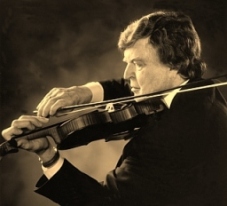
Emanuel Vardi

Emanuel Vardi (Emanuel Rosenbaum) was a Russian (many would say American or Israeli) violinist, violist, composer, arranger, conductor, teacher, and painter, born (in Jerusalem, Israel) on April 21, 1915.  There is anecdotal evidence which actually gives his date of birth as October 14, 1917.  He is known for having been one of only two violists to have ever given a solo recital in Carnegie Hall.  He was also the first violist to record the 24 Paganini (violin) Caprices – transposed a fifth lower, of course.  Vardi began his violin studies with his violinist father at about age 3 in Israel (Palestine, at that time.)  He began piano studies simultaneously with his pianist mother.  The family was already settled in New York when he – at age 6 - gave a piano recital in Aeolian Hall which created a very favorable impression, even among professional critics.  Vardi continued private violin lessons with Joseph Borisoff and others until age 12, at which time he entered the Institute of Musical Art, the precursor of the Juilliard School.  There, he studied with Constance Seeger.  It has been said that he also took one lesson from Leopold Auer, who died soon thereafter (1930.)  Later, he enrolled at Juilliard, where he studied with Edouard Dethier and Felix Salmond, among others.  However, he was then still a violinist.  At age 21 he left Juilliard to join the NBC Symphony as a violist.  He became the youngest member of this legendary orchestra.  Carlton Cooley and William Primrose were on the first stand of the viola section so Vardi was further back, but I don’t know how far back.  In any case, after Primrose left the orchestra, Vardi moved up to the first desk as Assistant Principal.  The ill-tempered Arturo Toscanini was the conductor.  Five years later, Vardi’s New York recital debut at Town Hall in February, 1941 was a sensation.  He was 25 years old.  He also soon thereafter played at the White House, accompanied by pianist Earl Wild, for President and Mrs. Franklin D. Roosevelt.  During World War II, he played in the Navy Band (the Navy’s Symphony Orchestra) and with the Navy’s string quartet, which included violinists Oscar Shumsky and David Stone (please see comments below), and cellist Bernard Greenhouse.  He was one of four official soloists, the others being Shumsky, Earl Wild, and David Soyer, whose duty it was to alternatively perform a concerto with the orchestra once every month.  After the war, Vardi rejoined the NBC orchestra, but continued to expand his solo activities.  On May 23, 1946, he appeared as viola soloist in Carnegie Hall with the New York Philharmonic - something considered unorthodox in those days - playing Alessandro Rolla’s viola concerto – Rolla had been a violinist and violist and was one of Nicolo Paganini’s teachers.  From 1950 to 1952, Vardi was studying art in Florence, Italy, and concertizing all over Europe, playing a 1770 Guadagnini violin.  Returning from Europe, Vardi again played with the NBC orchestra but became Principal Violist of the Symphony of the Air, the orchestra which was formed after the NBC Symphony was disbanded.  He also played with the Guilet Quartet, led by the last NBC Concertmaster Daniel Guilet – Guilet later organized the well-known Beaux Arts Trio.  By then, Vardi had begun to solidly put the viola on the musical firmament as a solo instrument.  From that point, Vardi’s career encompassed painting, teaching, concertizing, conducting, and recording with both classical and jazz and pop musicians - this was many years before crossover work had become fashionable or had even been contemplated by violinists Ivry Gitlis, Yehudi Menuhin, Itzhak Perlman, and Nigel Kennedy, and cellist YoYo Ma.  Among many others, he worked with Nat King Cole, Tony Bennett, Frank Sinatra, Barbra Streisand, Louis Armstrong, Sarah Vaughan, and Nina Simone.  As have Joshua Bell, Toscha Seidel, Louis Kaufman, Yehudi Menuhin, Ytzhak Perlman, Isaac Stern, Israel Baker, Endre Granat, and Glenn Dicterow, Vardi recorded for many movie soundtracks – Aladdin, Tootsie, Fame, Kramer Vs Kramer, and Sleepless in Seattle are among them.  He also championed contemporary composers and inspired them to write music for the viola.  A very rare audio file of Alan Shulman’s Variations for Viola (with Vardi and the NBC Orchestra) is available here.  YouTube also has various audio files of Vardi’s Paganini Caprices recording – you can listen to number 17 here.  Several of his solo recordings are also available on the internet although Vardi recorded on violin as well – the two Bartok Rhapsodies and the Tibor Serly violin concerto are examples of Vardi’s violin discography.  In the late 1970s and early 1980s (1978 to 1982), Vardi was chief conductor of the South Dakota Symphony.  In addition, he conducted for movie and television soundtracks.  In 1984, at age 69, as have several other highly gifted artists (Andre Previn, Charles Dutoit, Eugene Ysaye, Ole Bull, Pablo Casals, and Richard Wagner), Vardi married a much younger woman – violinist and painter Lenore Weinstock, a student of his.  They relocated from New York to the state of Washington in 2007.  By then, Vardi had injured an arm (in 1993 – I don’t know which arm) and had given up playing almost entirely.  He had nevertheless continued giving master classes, teaching privately, working with various music festivals around the world, and painting.  An iconic painting of William Primrose by Vardi can be seen at the Vardi art website.  I do not know where the original painting is.  I do know that Lenore Vardi plans to publish a book about Vardi’s life in the near future.  Among his many compositions for viola is the Fantasy Variations on a Theme of Paganini.  As far as paintings go, he completed more than 300 originals.  Vardi played two Strad violas early in his career – one of them the Strauss Stradivarius (Stradivari possibly only made between 13 and 18 violas – nobody knows for sure.)  I had not heard of the Strauss Strad viola until now.  The Strad violas I know of are the Archinto, the Axelrod, the Gibson, the Cassavatti, the Mahler, the Russian, the Tuscan, the Spanish Court, the MacDonald, the Paganini, and the Kux.  Nonetheless, Vardi’s favorite viola was one constructed in 1980 by Hiroshi Iisuka of Philadelphia.  He also played a Vincenzo Postiglioni violin.  Vardi died (in North Bend, Washington) on January 29, 2011, at age 95.

Thursday, February 16, 2012

Calvin Sieb

Calvin Sieb was an American violinist and teacher born (in Newark, New Jersey) on May 30, 1925.  He is known for having spent most of his career in France and Canada.  He started his violin studies at age five with Mandel Svet but in 1938, began his studies (privately) with Hans Letz, a well-known chamber music player and teacher of the time.  He continued with Letz until 1943, the year he graduated from Columbia High School.  He joined the U.S. Air Force in 1943 or 1944 and was discharged in 1945.  From 1945 until 1948 he was at the Juilliard School, studying with Letz and (perhaps) Ivan Galamian.  In 1949 and 1950, he studied with Emanuel Vardi, the famous violist, though at another music school.  In 1950 he went to France to study with Jacques Thibaud in Paris.  A year later, upon his return to New York, he accepted a position as violin professor at the Quebec Conservatory (1951-1956) and Assistant Conductor of the Quebec Symphony (1951-1953.)  He was 25 years old.  He was concertmaster of the CBC Symphony, with which he did a lot of studio work, from 1954 to 1958.  He then became, in 1960, concertmaster of the Montreal Symphony, remaining with the orchestra until 1979.  He was also an active recitalist and concert violinist during this time.  In 1970, he became a naturalized Canadian citizen.  While he played in the Montreal Symphony, he got to use the Laub Strad, purchased for the orchestra by John McConnell, a Canadian businessman.  According to Sieb, the first American performance of the Tchaikovsky violin concerto was played in Chicago on this instrument.  That is, of course, not true.  That American premiere performance of the Tchaikovsky concerto was given in 1889 by Maud Powell and the New York Symphony, and not with this violin.  In 1979, he relocated himself to France, where he became concertmaster of the orchestra in Toulouse.  He came back to Canada in 1989 and was appointed professor at the University of Ottawa.  He was 64 years old.  He retired from this post in 2001.  Somewhere along the way, he invented a mute and something called a violin chin rest pad.  Sieb died on May 21, 2007, at age 81.

Saturday, November 19, 2011

Edouard Dethier

Edouard Dethier (Edouard Charles Louis Dethier) was a Belgian violinist and teacher born (in Liege) on August 25, 1885.  Though he was a well-known recitalist and concert violinist for a time, he is now best remembered as a teacher at the Juilliard School of Music, since before it became the Juilliard School of Music.  He began his violin studies with his brother Gaston while still a child.  At the age of eight, he enrolled in the conservatory of his hometown (Liege), from which he graduated with a First Prize – Eugene Ysaye had studied there also (1865) as a seven-year-old child.  Dethier entered the Brussels Conservatory at age 15, winning a first prize one year later (at age sixteen) after entering the Brussels violin competition.  One year after that, he was already teaching at the Brussels Conservatory.  He was 17 years old.  He was then also appointed concertmaster of the opera orchestra of Brussels.  During his student days and early career, he was a close friend of Polish violinist, Paul Kochanski.  Dethier came to the U.S. (New York City) in 1905, establishing himself as a recitalist and teacher, although he toured for a few years.  He played the Vieuxtemps concerto in d minor (number 4) with the New York Symphony on June 6, 1905.  On November 29, 1907, he debuted with the New York Philharmonic, playing Bruch’s Scottish Fantasy.  He again soloed with this orchestra on December 18, 1910, playing the Tchaikovsky concerto.  Gustav Mahler conducted on that occasion.  By then, he had already been appointed (in 1906 or 1907 – sources vary) to the faculty of Juilliard – he was 21 years old.  As did Ivan Galamian after him, Dethier taught there until the day he died.  As far as I know, there are no commercial recordings by him and I also have no idea what violins he played.  After 1911, Dethier must have had no financial worries as he had that year married Avis Putnam, the daughter of a famous publisher.  Among his many pupils were Julius Hegyi, Robert Mann, Louis Lanza, Emanuel Vardi, Sally Thomas, Genevieve Greene, Julius Schulman, Anna Tringas, Joan Milkson, and Paul Zukofsky.  Dethier died (in New York City) on February 19, 1962, at age 76. 

Sunday, August 23, 2009

William Primrose

William Primrose was a truly outstanding Scottish viola player of the Twentieth Century. He was born on August 23, 1904 (Heifetz was 3 years old.) His first violin lessons were with his father, John Primrose, a violinist in the Scottish Orchestra. After graduating from the Guildhall School of Music in 1924, he played violin wherever he could. Two years later, he began lessons with (the 68-year-old) Eugene Ysaye, who, it is said, encouraged him to give up the violin in favor of the viola. Nobody knows why and I haven't done enough research to find out. Anyway, "what's done cannot be undone." From 1930 until 1935, he played viola in the London String Quartet. In 1937, he joined the NBC Symphony Orchestra as assistant principal violist but left after he heard that Toscanini would be quitting the conductor's post in 1941. He was there for four years. Eventually, his solo career really took off. He was the first violist to record Harold In Italy, Berlioz's famous viola concerto (or tone poem or fantasy or whatever it is). That was in 1946. This is the same piece Paganini refused to play because it was not dazzling enough, though that is just a rumor. Who really knows? Primrose also premiered Bartok's Viola Concerto (1949). He was so technically brilliant that he could play Paganini's violin caprices on the viola - no small accomplishment. Nevertheless, Emanuel Vardi was the first to record the Caprices on the viola. Primrose played an Amati viola (which is really a reconstructed viola – originally much larger) now owned by the former principal violist of the Philadelphia Orchestra, Roberto Diaz. Later in his life, Primrose was a distinguished teacher at Indiana, USC, Juilliard, and other schools and wrote several method books. There are several videos of his playing on YouTube. As far as I know, Primrose is the only violist in history to have a star on the Hollywood Walk of Fame. He died on May 1, 1982, at age 77.