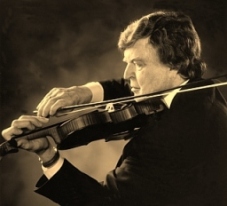
Eda Kersey was an English violinist and teacher born
(in Goodmayes, a district of London) on May 15, 1904. She was a very accomplished musician whose
career was mostly spent in England. She
was also one of quite a few female violinists who died young – Maud Powell, Johanna
Martzy, Ginette Neveu, Edith Volkaert, Alma Rose, Alma Moodie, and Arma Senkrah
are among them. Several sources speak
very highly of her and emphasize that she would have left a great legacy if
only she had lived long enough to record the great works of the violin
repertoire. She is also known to have
stated that practicing seven hours a day (which she routinely did) should be
sufficient for any violinist. Her
musical education began on the piano at age four. She took up the violin at age six when she actually
began studying at the Trinity College of Music in London. Two years later, she was awarded a
certificate from the college with very high marks. She was eight years old. After that, she began studying with Edgar
Mouncher (a pupil of Otakar Sevcik.) After
only two years, at age ten, she played Wieniawski’s second concerto (first
movement only) in Southampton, a city which is 65 miles from London. That concert (in 1915) was a great
success. At age 13, she moved to London
to live with an aunt and uncle in London and began studying with Margaret
Holloway, a pupil of Leopold Auer. Her
first London recital took place three years later at the Aeolian Hall when she
was sixteen years old. (New York City
also had its own Aeolian Hall.) Along
the way, she premiered the concertos of Arnold Bax, Erno Dohnanyi, and Stanley
Wilson, as well as works by other contemporary composers. She also gave the first English performance
of the Barber concerto at a Proms concert in 1943. Her first Proms concert had been in 1930
playing the Beethoven concerto with the famous Henry Wood conducting. She was 26 years old. That performance was the first of several
appearances she made at the popular Proms concerts. In 1931, she formed a piano trio which was
simply named The Trio Players. Her last
concert took place in June, 1944, at the Albert Hall in London. Kersey played a Nicolo Amati, a J.B.
Vuillaume, and a Guarnerius del Gesu (which she acquired from Belgian violinist
Alfred De Reyghere in 1942), among other violins. Eda Kersey died on July 13, 1944, at age 40. Negotiations for many recordings of the
standard repertoire had nearly been concluded before her sudden death but she
never got to actually record anything other than some small pieces (with piano
accompaniment) and the Bax concerto (with orchestral accompaniment) several
months earlier.
Showing posts with label Maud Powell. Show all posts
Sunday, January 6, 2019
Thursday, February 16, 2012
Calvin Sieb
Calvin Sieb was an American violinist and teacher born (in Newark, New Jersey) on May 30, 1925. He is known for having spent most of his career in France and Canada. He started his violin studies at age five with Mandel Svet but in 1938, began his studies (privately) with Hans Letz, a well-known chamber music player and teacher of the time. He continued with Letz until 1943, the year he graduated from Columbia High School. He joined the U.S. Air Force in 1943 or 1944 and was discharged in 1945. From 1945 until 1948 he was at the Juilliard School, studying with Letz and (perhaps) Ivan Galamian. In 1949 and 1950, he studied with Emanuel Vardi, the famous violist, though at another music school. In 1950 he went to France to study with Jacques Thibaud in Paris. A year later, upon his return to New York, he accepted a position as violin professor at the Quebec Conservatory (1951-1956) and Assistant Conductor of the Quebec Symphony (1951-1953.) He was 25 years old. He was concertmaster of the CBC Symphony, with which he did a lot of studio work, from 1954 to 1958. He then became, in 1960, concertmaster of the Montreal Symphony, remaining with the orchestra until 1979. He was also an active recitalist and concert violinist during this time. In 1970, he became a naturalized Canadian citizen. While he played in the Montreal Symphony, he got to use the Laub Strad, purchased for the orchestra by John McConnell, a Canadian businessman. According to Sieb, the first American performance of the Tchaikovsky violin concerto was played in Chicago on this instrument. That is, of course, not true. That American premiere performance of the Tchaikovsky concerto was given in 1889 by Maud Powell and the New York Symphony, and not with this violin. In 1979, he relocated himself to France, where he became concertmaster of the orchestra in Toulouse. He came back to Canada in 1989 and was appointed professor at the University of Ottawa. He was 64 years old. He retired from this post in 2001. Somewhere along the way, he invented a mute and something called a violin chin rest pad. Sieb died on May 21, 2007, at age 81.
Saturday, October 23, 2010
Maud Powell
Maud Powell was an American violinist, writer, and arranger born on August 22, 1867 (Brahms was 34 years old.) She is remembered for having been a concert violinist at a time when women violinists – even among orchestral players - were a rarity. Her career was spent almost exclusively in the U.S. Her first violin studies began when she was seven. At age 9 she became a pupil of William Lewis in Chicago. She then began playing in and was soon made assistant concertmaster of the Aurora (Illinois) Symphony Orchestra. Her debut as soloist with this orchestra took place in 1880. She further studied in Europe with Henry Schradieck in Leipzig (1881-1882) and Charles Dancla in Paris (1882-1883.) She spent a year intermittently concertizing in London and then studied briefly with Joseph Joachim (1884-1885) who conducted the orchestra when she gave her Berlin debut with the Berlin Philharmonic in March of 1885 playing the Bruch g minor concerto. Returning to the U.S., she gave her New York debut with the New York Philharmonic on November 14, 1885 again playing Bruch’s first concerto. She was then eighteen years old. She soon began including works by contemporary American composers in her programs, including Arthur Foote, Henry Huss, Victor Herbert, and John Carpenter. She gave the American premieres of the Tchaikovsky and Sibelius concertos. Her fan club claims she premiered the Dvorak concerto as well but that is not true. Max Bendix premiered the Dvorak concerto with the Chicago Symphony on October 30, 1891. Powell gave the first New York performance of the concerto in 1893 but that's all. Mastering a very extensive repertoire, Powell also frequently played the concertos of Saint Saenz, Lalo, Arensky, Conus, and Rimsky Korsakov, among others. Her premiere of the Sibelius concerto on November 30, 1906 was especially significant although this concerto did not enter the standard violin repertoire until after Jascha Heifetz championed it. Powell founded a quartet in 1894 and a trio in 1908. She frequently wrote her own program notes and wrote numerous articles for music journals. I don’t know if she ever took students. Among her many violins was a supposed JB Guadagnini (1775) which was later sold to Henry Ford, the car maker. The Guadagnini was later declared (by Kenneth Warren) to actually be a copy made by New York Luthier George Gemunder on or about 1865. (She had purchased - around 1886 - a violin from a dealer named Victor S. Flechter which turned out to be a fake. Powell later sued the dealer because she had paid $500 and the violin was said to be worth only $40. The violin had supposedly been made by Gaspard Duiffoprugcar in 1515.) Powell also owned a Guarneri from 1731, the Mayseder Guarneri. She did a lot of recording for RCA during the industry’s infancy (1904-1907). YouTube has postings of a few of her recordings. Maud Powell died (in Uniontown, Pennsylvania) on January 8, 1920, at age 52, while preparing for a concert. Tuesday, January 5, 2010
Erica Morini
Erica Morini (Erika Morini) was an Austrian violinist born on January 5, 1904 (Heifetz was 3 years old.) Morini was known for a refined, silken tone and for being one of the few female concert violinists of the early twentieth century. She received her first instruction from her father (Oskar Morini, student of Joseph Joachim) and mother and completed her studies under the famous pedagogue Otakar Sevcik although she also studied with Jakob Grun, Alma Rose, and Adolf Busch. In 1916, she made her orchestral debut in Vienna, playing Mozart's A major concerto. In 1917, she made her debut in Berlin under Arthur Nikisch. Her U.S. debut in New York on January 26, 1921 (in Carnegie Hall) was a phenomenal success. She was 17 years old. Soon afterward, Maud Powell's Guadagnini violin was presented to her, though most likely only as a loan, since the instrument was later sold to Henry Ford, the car maker. She made her first visit to London in 1923. When she was 21, her father purchased the Davidoff Strad from a Paris dealer for her and that's the instrument she used for the remainder of her career. After 1938, Morini lived in New York City. She concertized far and wide until her retirement in 1976. She was 72 years old. It has been said that she taught Jascha Heifetz the bowing technique known as staccato. There are numerous recordings of hers still available and at least one video on YouTube. Some time in 1994 or 1995, her Stradivarius was stolen from her Fifth Avenue apartment but (according to one source), Morini was never told about the theft. It has not been heard from since. Whether the instrument was insured or not is unknown to me. Erica Morini died on October 31, 1995, in relative obscurity, at age 91. Saturday, December 19, 2009
Charles Dancla
Charles Dancla was a French violinist and teacher born on December 19, 1817 (Beethoven was 47 years old and Paganini was 35 years old.) He began his studies while still a child and later studied with Pierre Baillot for a number of years. In 1835, he became concertmaster of the Paris Opera Orchestra. Between 1848 and 1855 he joined the French Civil Service but continued to play informally. (Pierre Baillot had done something similar.) In 1855 - after years of political intrigues - he was made professor of violin at the Paris Conservatory and taught there for more than 35 years. One of his pupils was Achille Rivarde. Another famous pupil he had was Maud Powell. Dancla wrote many violin concertos, orchestral pieces, 14 string quartets, and many other works for violin, none of which are played today, except perhaps in France. The Dancla Stradivarius violin of 1703 is named after him. He used it for 22 years - between 1854 and 1876. It is now being played by Linus Roth. However, among other very fine violins, he also played a 1710 Stradivari which also bears his name and was later owned and played by Nathan Milstein. Dancla died on October 10, 1907, at age 89 (Stravinsky was 25 years old and Heifetz was already six years old.)
Subscribe to:
Comments (Atom)